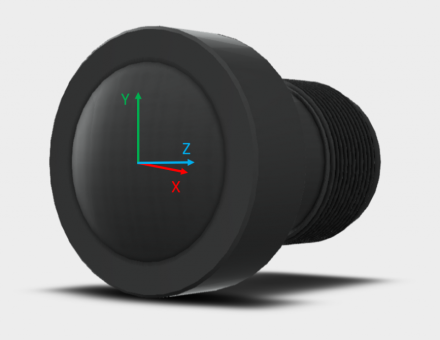
Boresight Stabilization™ is Sunex’s proprietary lens design technique that keeps the optical axis aligned under mechanical shock, vibration, and thermal stress. Without it, lens axis shift under real-world conditions causes calibration drift in AI vision systems — leading to object detection errors in automotive ADAS, aerial surveillance, and industrial inspection deployments.
This article explains what boresight is, why it matters for harsh-environment cameras, and how Sunex engineers Boresight Stabilization™ into OEM lens designs.
What is boresight stabilization in optical lens design?
A typical lens assembly consists of several lens elements inside a cylindrical barrel. Due to the mechanical clearance requirement, the internal element diameters must be smaller than the barrel internal diameter.
This creates potential risks that could result in boresight errors or changes:
- Lens to lens variance of the optical axis due to manufacturing tolerance
- A possible lateral shift of individual elements overtime due to strenuous conditions
How does Sunex Boresight Stabilization™ reduce pointing error?
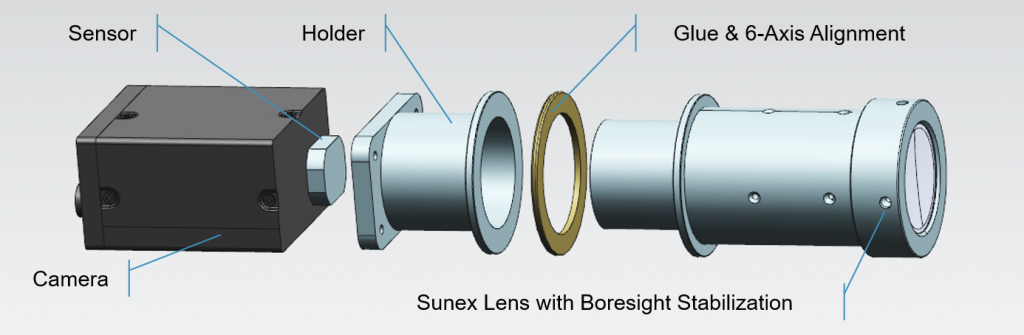
The first potential risk (lens-to-lens variance) can be reduced and even completely mitigated through the use of Active Alignment of the sensor and lens assembly during the manufacturing process. Sunex typically recommends active alignment for imaging requirements of >3 – 5MP or for sub 2um pixel pitch. Pairing a high-quality, precision optic with an imprecise alignment method may not fully realize the performance, especially edge MTF, that the lens itself is capable of delivering on a consistent basis.
The second one is less predictable and depending on the severity could have a devastating impact on certain applications. To eliminate this potential risk for boresight error, Sunex has created an optomechanical design process that allows for risk evaluation on a per-element basis, and developed technologies and processes to “glue” these identified lens elements laterally into the barrel. Boresight Stabilization™ designs are fully compatible with Sunex’s general manufacturing process and deliver on:
- Best-practice kinematic design and mounting of elements
- Superior tolerancing of optical design and between lens elements and mechanics
- Superior assembly and test techniques
How do vibration and temperature affect lens optical axis alignment?
To show an example of the positive impact of Boresight Stabilization™ on the overall lens performance in harsh environments, Sunex created a test under the following conditions:
- Two lenses with the same PN, built with the same process, except one lens is boresight stabilized, the other is not.
- Both lenses initially meet all relevant specifications for optical performance, including MTF.
- Both lenses subject to the same Temp/Vibe/Temp/Vibe cycle.
- Both lenses retested for MTF after the test cycle was completed
The below graphs clearly shows that the standard lens had more than twice* the MTF degradation as the Boresight Stabilized™ lens after only one test cycle.
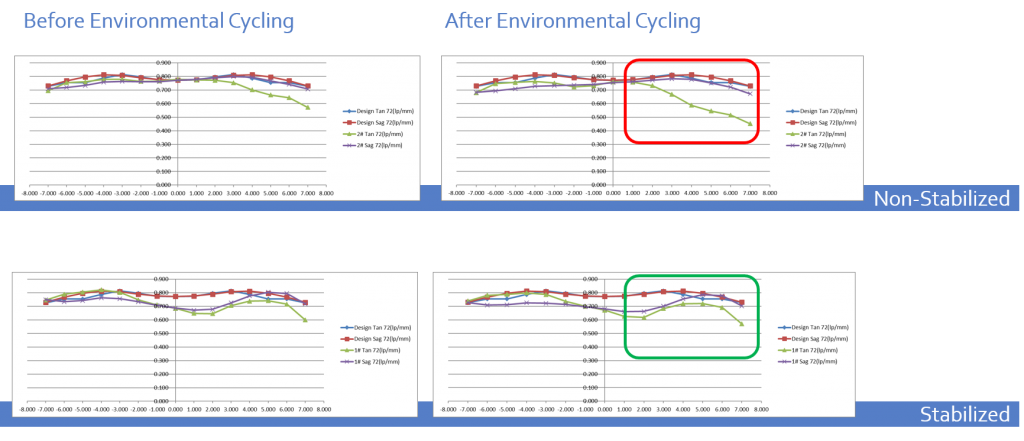
*results might differ for other lens designs or different test procedures
Which Sunex lenses include Boresight Stabilization™ technology?
Theoretically, every lens can be designed from the start, with Boresight Stabilization™, and existing off-the-shelf lenses can be retrofitted; however, the application needs to determine whether it is needed or not. There is no need to “throw the kitchen sink at it”. For example, we have shipped over 100 million lenses to automotive customers, and all designs must pass a rigorous reliability and environmental test protocol that simulates 15 years of vehicle lifetime. 99% don’t have any Boresight Stabilization™.
But if a particular lens is designed with Boresight Stabilization™ it achieves the following goals:
- Enhanced survivability
- Stable boresight (pointing) over shock, vibration, and temperature
- Enhanced MTF stability and repeatability over the mechanical shock, vibration, and temp (The lens stays better, longer and returns to a predictable performance after being subject to environmental extremes)