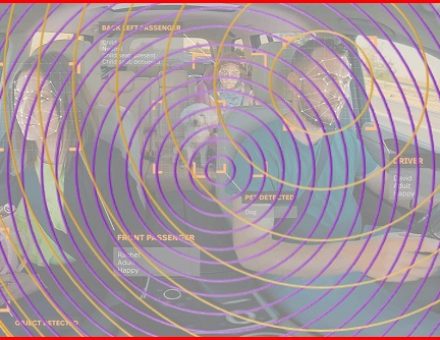
In-cabin automotive cameras are evolving beyond basic driver monitoring to simultaneously cover occupant sensing, gesture control, gaze tracking, and child presence detection. The optical challenge is designing a single lens system that handles near-IR illumination, wide FOV, low distortion, and high MTF across a cramped cabin space — while meeting AEC-Q automotive qualification and EU GSR/NCAP regulatory requirements.
This article covers optical requirements for in-cabin monitoring (ICM) systems, RGBIR lens design considerations, and how Sunex’s in-cabin lens portfolio addresses emerging automotive regulations.
What optical requirements do automotive in-cabin monitoring systems need?
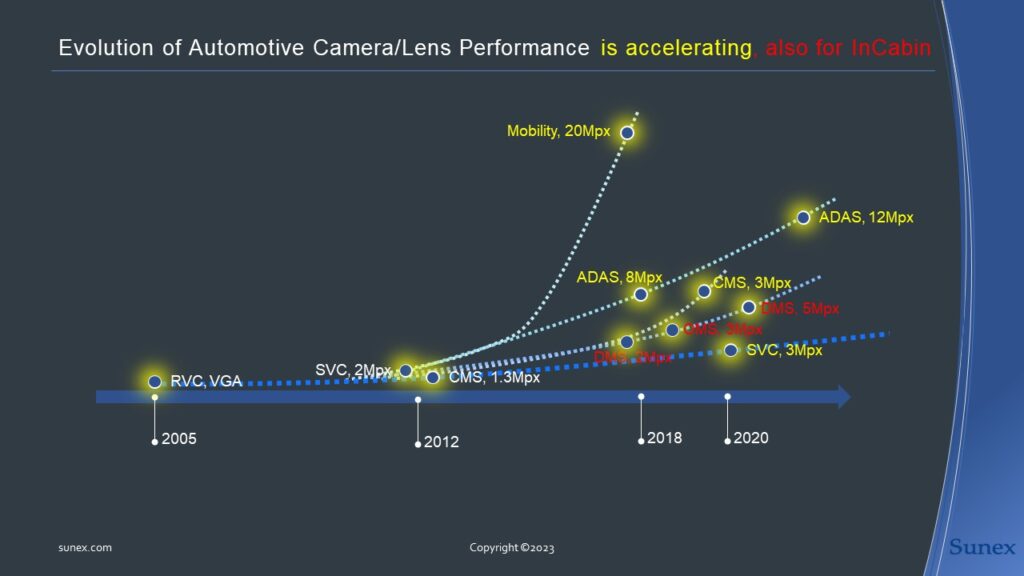
One thing seems to be agreed on across the industry: InCabin vision applications will expand rapidly, similar to the evolution of cameras pointing outwards.
Exterior cameras in automotive advanced from a single low-resolution backup camera to advanced, high-resolution, and AI-powered ADAS systems. One can easily imagine that the InCabin revolution will expand from the initial focus on DMS to many vision-based applications. The industry and regulatory bodies will need and require additional vision applications supporting the progression from L2+ to L5 autonomy, and OEMs want to satisfy the demand of consumers to make their cars an essential part of their interconnected world.
What is an RGBIR lens and why is it used for in-cabin cameras?
The lens has always been an integral part of every camera system. Even though it is often seen as a commodity nowadays, the lens is a crucial driver, differentiator, and innovator for performance. No sensor or AI algorithm alone can deliver if the input signal is inadequate for the intended application.
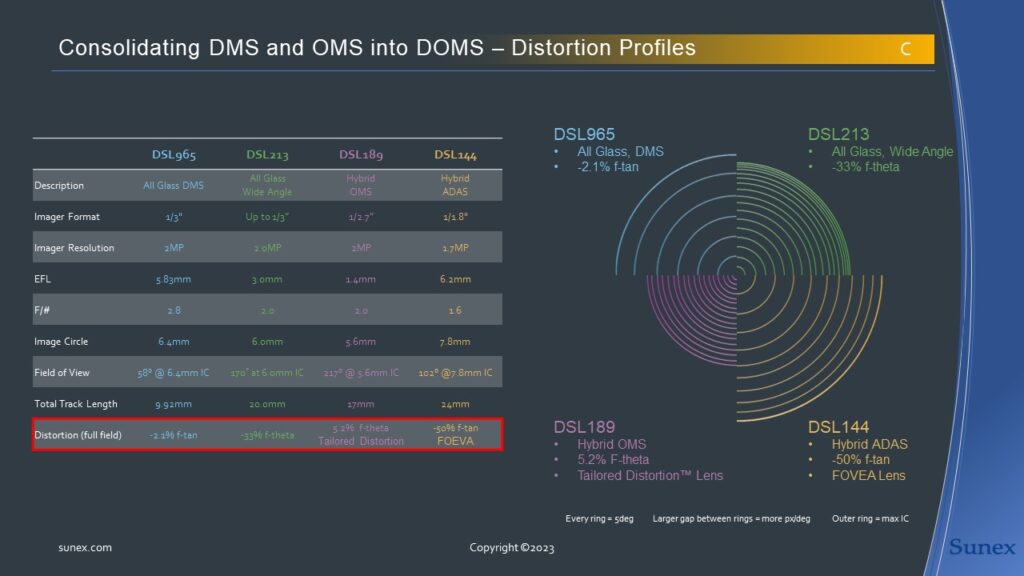
Optical design and manufacturing technologies for achieving high enough resolution for biometric recognition, enabling radial symmetric tailored distortion for super wide-angle views, and optimizing coatings for RGBIR, to list a few, require specific domain expertise that often can only be built over time and are hallmarks for experienced suppliers. Adding into the mix the progression to 5G, we will undoubtedly see InCabin video streaming and conferencing as a sought-after option for the future car as well.
How does Sunex design lenses for NCAP and GSR in-cabin camera requirements?
Sunex has been working with leading companies on the aforementioned technologies for many years. Initially, they have been regarded as groundbreaking and key differentiators in their respective industries and now have become recognized standards. The challenge is now how to adapt these for the automotive industry. Some of the approaches will borrow from previous solutions, e.g., RGBIR in automotive has been called Day/Night in Security for a long time, Occupant Monitoring (OMS) could potentially leverage Surround View Camera (SVC) experiences, and design expertise for finite imaging in Machine Vision (MS) drives some of the Driver Monitoring (DMS) innovations.
However, balancing expected performance, size constraints, and cost targets remains one of the most crucial success driver in the automotive industry, and this talk will discuss some of the required optics technologies, their advantages, and cost challenges for In-Cabin applications that meet regulatory requirements.
This article is the abstract to the presentation given at the InCabin show in Phoenix in March 2023.
Download the presentation by clicking on the cover