
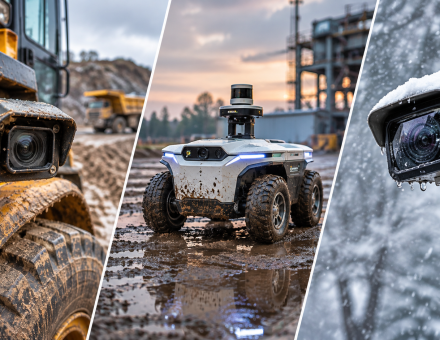
Cameras in harsh environments rarely fail electrically. They go blind at the first lens surface, or they drift out of focus as temperature moves the optics. We address that with Sunex AlwaysClear(TM) technologies, which can be used alone or combined.
A hardened front element (HyperTuff™), HP3 hydrophobic coating with IP6K9K sealing, direct or indirect lens heating, ultrasonic self-cleaning, anti-static surfaces, and passive athermalization.
Each has clear advantages but also limitations. Sticky mud defeats ultrasonic cleaning, heaters cost battery life, and no coating removes ice. For off-highway vehicles, robots, and security cameras, the answer is usually one passive layer stack plus one active method, chosen for your contamination, power budget, and cleaning access.
Environmental Protection for Camera Lenses: Technologies That Keep OHV, Robotics, and Security Cameras Seeing
Image quality degradation from environmental exposure usually shows up over time; it is not a pass/fail spec violation. A camera comes back from a season on a wheel loader with its front element hazed by fine scratches. A delivery robot stalls at a curb because one water droplet sits in the middle of its depth camera. A perimeter camera delivers a washed-out image every night because its own infrared light bounces off a film of dust.
None of these cameras failed electrically. They lost to the environment, and that typically manifests itself in one of two places: the first optical surface, or the few tens of microns between the lens and the sensor.
We group our answers to those problems into an Environmental Protection Technology Suite. The technologies can be used individually or combined, and they come down to six building blocks:






Hyper Scratch-Resistant
Hydrophobic Coating
Lens Heating
Ultrasonic Cleaning
Anti-Static
Passive Athermalization
This article walks through each one: what it does, what our test data shows, and where it stops working. Then we look at how they combine in three markets where the environment is the main design input: off-highway vehicles (OHV), robotics, and security.
Read this first: protection is a system, not a feature
No single technology on this list keeps a camera clean, dry, sharp, and unscratched. A hydrophobic coating does little against ice. A heater does nothing against dust. The numbers below come from our own tests on specific samples; they are starting points, not guarantees for your duty cycle.
Why does the first lens surface decide whether your camera survives the field?
Optical engineers call it L1S1: the first surface of the first lens element. It is the only optical surface that touches the outside world, so it takes the rain, the grit, the pressure washer, and the rag someone wipes it with.
A common reflex is to put a flat cover window in front of the lens and treat the window as sacrificial. Sometimes a window is mandatory. But every added surface costs transmission, adds a ghost path, and creates an air gap that can fog from the inside. Our default goal is to eliminate optical surfaces where we can and make L1 itself the barrier.
Field of view makes this more than a preference. For lenses approaching 180°, a flat window stops being an option, because rays from the edge of the field would meet it at grazing angles. The front element has to do the job.
The Environmental Protection Technology Suite at a glance
| Threat | Sunex technology | Type | |
|---|---|---|---|
 | Scratches, grit, impact | HyperTuff™ L1, HyperCoat™ hard coating, impact-resistant coatings | Passive |
 | Rain, spray, washdown | HP3 hydrophobic coating, IP6K9K sealing | Passive |
 | Fog, frost, ice | Direct L1 heating, indirect barrel heating | Active (2 to 5 W in our tests) |
 | Dust, droplets, frost on the surface | Ultrasonic self-cleaning | Active (3 to 5 W peak per transducer) |
 | Dust attracted by static charge | Anti-static technology | Passive |
 | Focus drift over temperature | Passive athermalization, boresight stabilization | Passive, by design |
How hard does the first lens element need to be if the dust is harder than glass?

Here is the uncomfortable materials fact behind most scratched lenses. Quartz, the main mineral in most sand, sits at 7 on the Mohs hardness scale. Ordinary glass sits at about 5.5. Wiping a dusty lens with a glove drags a harder material across a softer one.
Anti-reflection and hydrophobic layers are thinner than the glass under them, so they go first. The image doesn’t fail suddenly. Contrast drops and flare grows, until the detection range in the validation report no longer matches what the machine sees.
We harden L1 in three steps that build on each other:
- HyperCoat™: a DHC-type hard coating on standard, commercially available glass. It is the lowest-effort step, because the optical design stays as it is.
- HyperTuff™ substrate: a proprietary conversion of the lens design to an ultra-hard L1 material, for applications where a coating on standard glass isn’t enough.
- HP3 on top: an impact-resistant, monolithic hydrophobic coating, so the hardened surface also sheds water.
If you’re specifying a camera for a machine that gets cleaned by whoever is nearest with whatever is in their hand, the wipe test in your requirements matters more than the rain test. Write the abrasive, the load, and the number of cycles into the specification.
Harder is not free
An ultra-hard front element changes the optical design and the cost. For a camera behind a windshield or inside a sealed dome, it buys nothing. We recommend it when L1 is exposed and gets touched or blasted, and we’ll say so when a hard coating is enough.
What does a hydrophobic coating really buy you, and how long does it keep working?
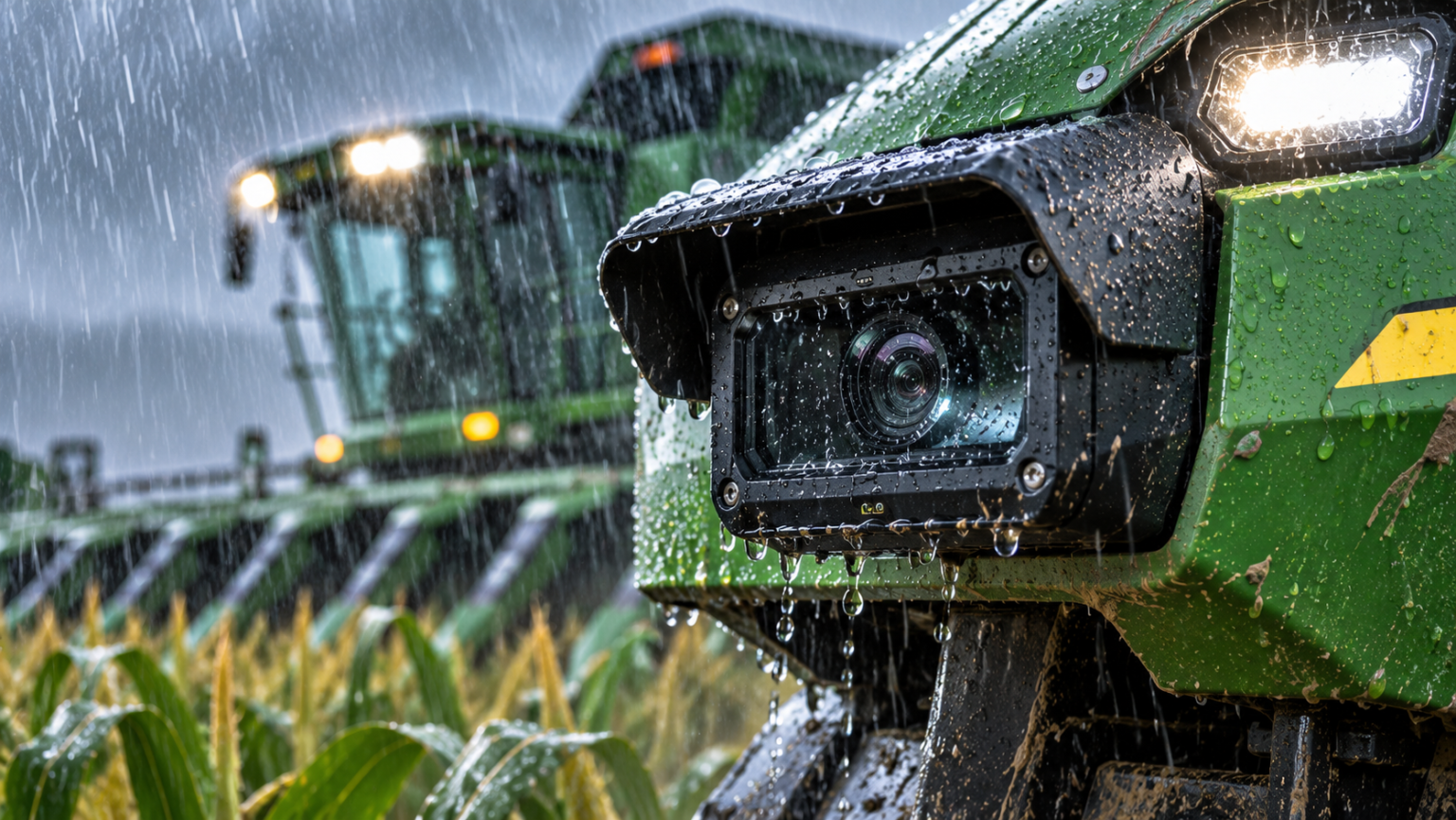
Hydrophobic means water-repelling. The standard measure is contact angle: the angle a droplet makes where it meets the surface. Above 90°, water beads instead of spreading, and the larger the angle, the more water-repellent the surface.
The benefits are practical: less dirt retention, a degree of self-cleaning, better moisture and corrosion resistance, and a longer life for the surface underneath. The question a procurement team should ask isn’t the contact angle on day one. It’s the contact angle after abuse.
We test HP3 that way. In a Taber-type abrasion test (CS-5 wheel, 1 kg load, 3,000 passes in 9 cycles), the contact angle measured 113.9° before and 104.2° after. That is still well inside hydrophobic territory.
UV is the slower enemy. In a UV exposure comparison across four lens types, the contact angle dropped by between 8.6° and 24.0°. Within the 8-megapixel group, lenses with a wider horizontal field of view shifted more; a 3-megapixel, 200° lens shifted least. The largest shift in that set ended at about 90°, right at the boundary. That spread is why we verify on your lens geometry instead of assuming from a datasheet.
Coatings keep water off the glass. Sealing keeps it out of the lens. For vehicles, the reference is ISO 20653, and its toughest combination is IP6K9K: dust-tight, plus resistance to high-pressure, high-temperature jets. The 9K test sprays water at about 80 °C and 8 to 10 MPa from 10 to 15 cm, at four angles for 30 seconds each.
Customer scenario
If your camera sits on a machine that is pressure-washed every shift, ask two separate questions. Does the lens stay sealed (IP6K9K)? And does the coating survive the wash chemistry and the brush? They are different tests, and passing one says nothing about the other.
Should you heat the front lens or the whole barrel?

Fog, frost, and ice share one cure: put heat where the water is. There are two ways to do it, and they solve different problems.
Direct heating: energize the front element
A conductive, resistive coating is applied to the L1 glass and powered. The heat arrives exactly at the surface that needs clearing. In our test starting at -20 °C, a direct-heated lens drawing 3 to 4 W had about half of its clear aperture defrosted after 30 seconds and all of it after one minute. The whole front surface was defrosted at 1:50 and dry at 2:30.
Indirect heating: warm the barrel
A heater warms the lens barrel, and the barrel warms everything else. It is slower at the front surface, but it treats the lens as a whole, including the internal air spaces where condensation forms. One integration detail to plan for early: the sensor board needs two contacts to power the heater.
Barrel heating defrost test: -15 °C, 0.5 mm ice layer, 48.3 Ω heater
| Heater power | Time to defrost | Energy used (power × time) |
|---|---|---|
| 2.0 W | 123 s | about 246 J |
| 3.6 W | 82 s | about 295 J |
| 5.0 W | 72 s | about 360 J |
Read the last column carefully. Going from 2.0 W to 5.0 W cut the defrost time by about 40%, but it used almost 50% more energy. If you’re on a 24 V machine with power to spare, take the speed. On a battery, the slow setting is the efficient one.
Direct vs. indirect heating: where each has the advantage
| Metric | Direct heating (L1) | Indirect heating (barrel) |
|---|---|---|
| Ice, time to clear | Advantage | – |
| External water | Advantage | – |
| Internal condensation | – | Advantage |
| Temperature stability | – | Advantage |
| Power capacity | – | Advantage |
| Cost | – | Advantage |
| Complexity | Similar: needs active power | Similar: needs active power |
| Choose it when | Clearing L1 fast is the top priority | The whole lens, even the sensor, must stay clear |
Can a lens shake itself clean without a drop of washer fluid?
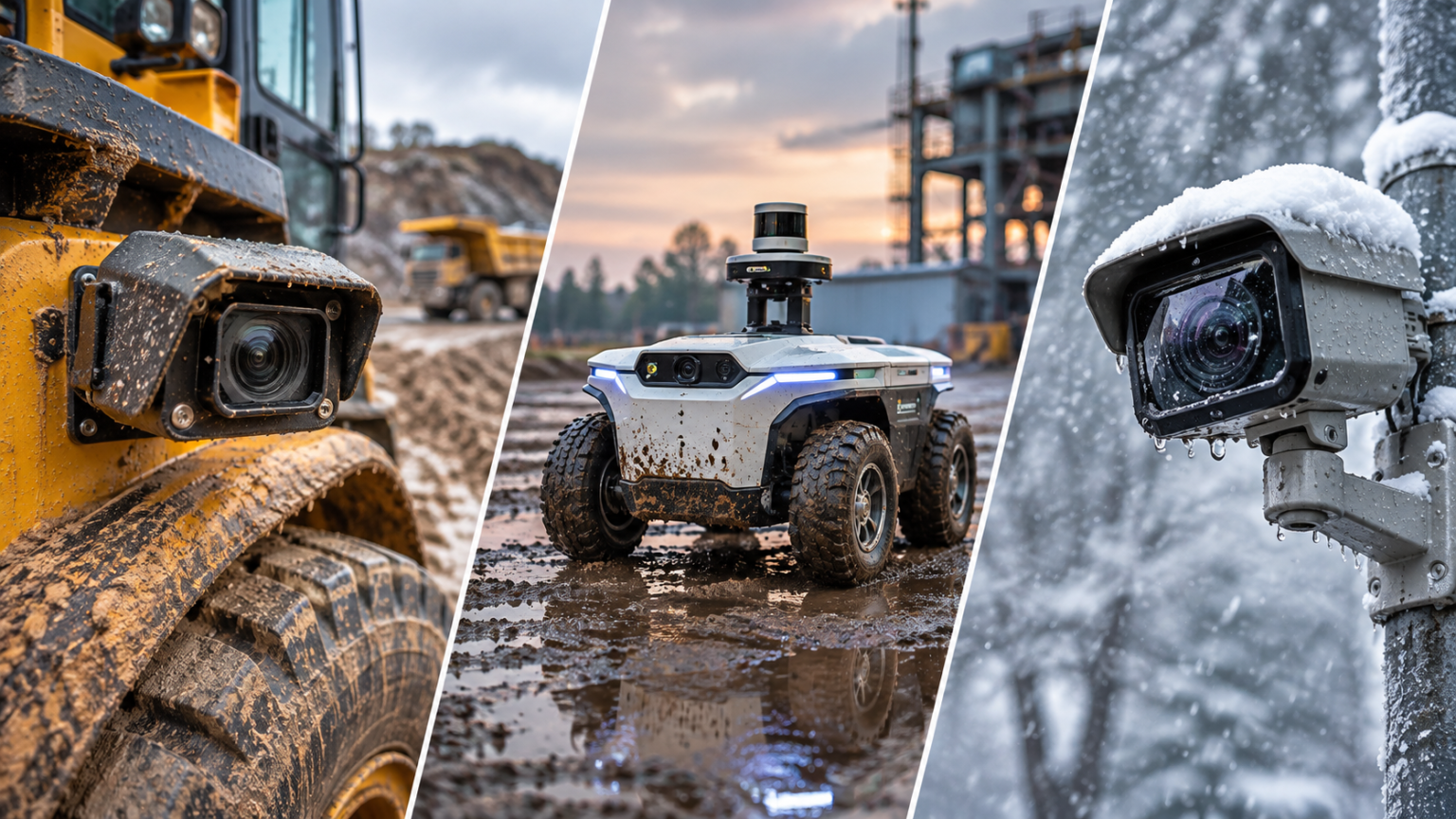
Washer nozzles work, but they need a tank, a pump, a hose, and someone to refill them. Ultrasonic cleaning removes contamination with the glass itself, in four steps:
- Excitation. Piezoelectric transducers generate ultrasonic waves at tuned frequencies.
- Propagation. The waves travel through the glass and form standing-wave patterns.
- Displacement. Micro-vibrations break the adhesion between particles and the surface.
- Ejection. Acoustic radiation pressure pushes particles and droplets off the glass.
There is no wiper and no nozzle, and by default no fluid, although water can be added to help with solids such as dust or mud. It works with visible and near-infrared cameras, including time-of-flight and LiDAR, without a significant effect on nominal performance.
Our current window implementation gives a sense of scale: a module 27.4 mm in diameter and 2.6 mm thick around a 20 mm window with an 11 mm clear aperture, driven from 12 V DC at no more than 3 W, in a 30 to 150 kHz band. Peak surface amplitude is 5.2 µm. You can’t see it move.
Ultrasonic cleaning response targets by contamination (window implementation)
| Contamination | Target time to clear |
|---|---|
| Dust | 5 s or less |
| Water | 8 s or less |
| Fog | 25 s or less |
| Frost | 25 s or less |
| Snow | 60 s or less |
| Ice | 250 s or less |
The drive runs in bursts, for example 10 seconds of short pulses followed by 10 seconds of rest, which keeps average power well below the 3 to 5 W peak. A frequency sweep covers different particle sizes, and resonance tracking follows the glass as its temperature changes.
Where ultrasonic cleaning is not the right fit (yet)
Three limits, stated plainly. Mud: sticky, viscous mud-water is the hardest contamination for this architecture, so plan on fluid assist or a different primary method. Geometry: circular flat windows work best, curved circular elements next, and square windows least. The clear aperture is currently limited to about 30 mm, with a minimum thickness of 1.5 mm for a flat window and 1.0 mm for a lens section. That suits narrow-field cameras behind a window; integration directly into a wide-angle or fisheye L1 is in R&D. Validation: similar products built from the same components and processes have passed -40 to 105 °C and 85 °C / 85% RH testing, and the module has run 500 hours continuously, but salt-spray and automotive-specific combined-environment tests were still open at the time of writing.
Material and geometry together set the resonance, so send drawings early.
Why clean a lens that never got dirty in the first place?
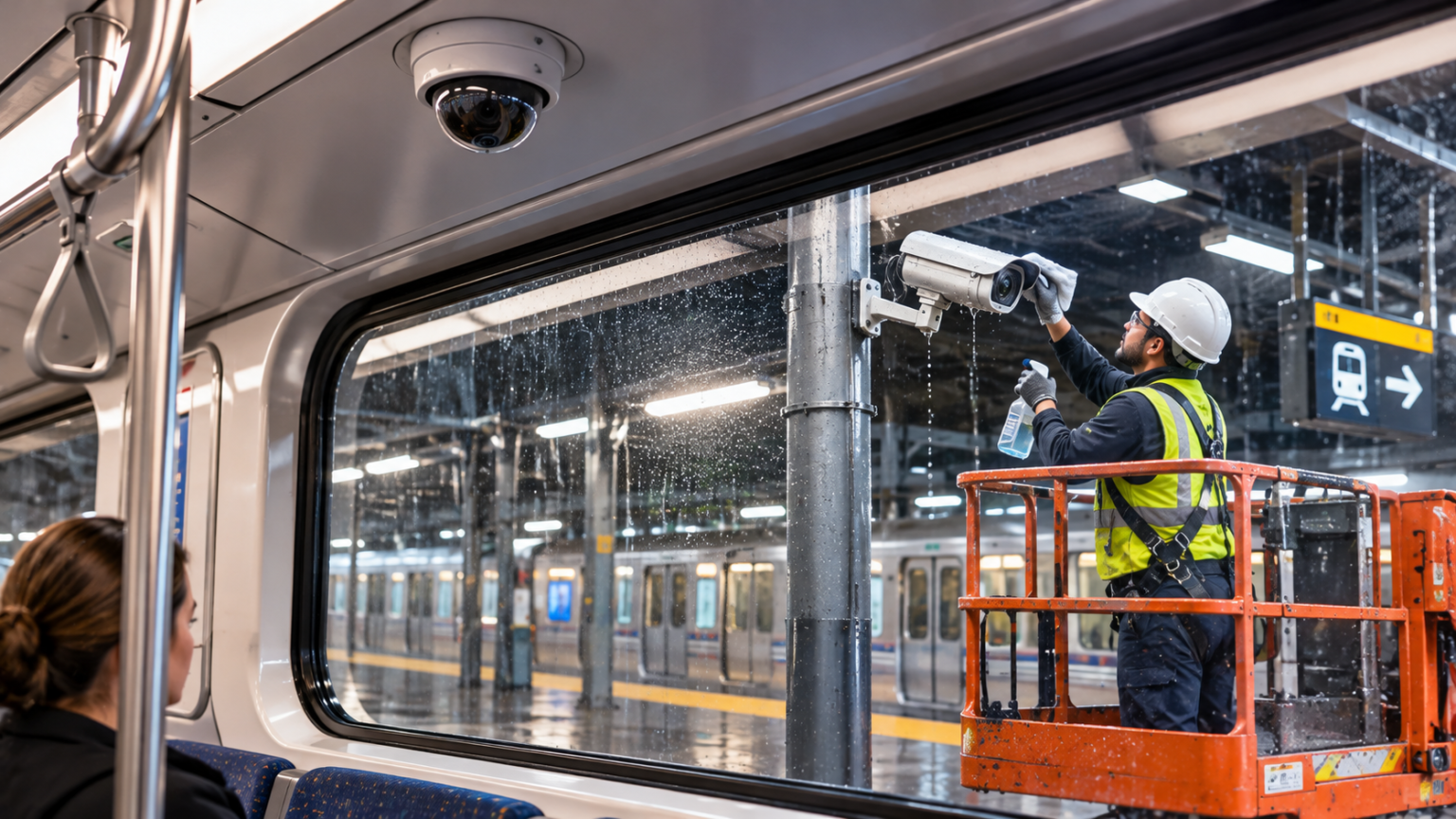
The cheapest cleaning cycle is the one you don’t need. Dry dust doesn’t only land on a lens. It gets pulled there. Dust can generate static charge as it moves, and glass is good at holding the opposite charge. The result is a film of fine particles that clings even to a vertical or downward-facing lens and returns soon after it is wiped away.
Our anti-static technology takes a passive route: reduce the surface charge on L1 so dust has less reason to stick. It draws no power and has no moving parts. A surface that attracts less dust also needs fewer wash or ultrasonic cycles.
If your cameras work in dry, dusty air, such as a cement plant, a grain terminal, or a desert solar site, electrostatic attraction is often a large part of the problem, and this is the first option to evaluate. The limit is in the name. Anti-static treatment addresses electrostatic attraction. It won’t stop wet mud, oily films, or insects.
Why does focus drift with temperature, and how do you stop it without moving parts?
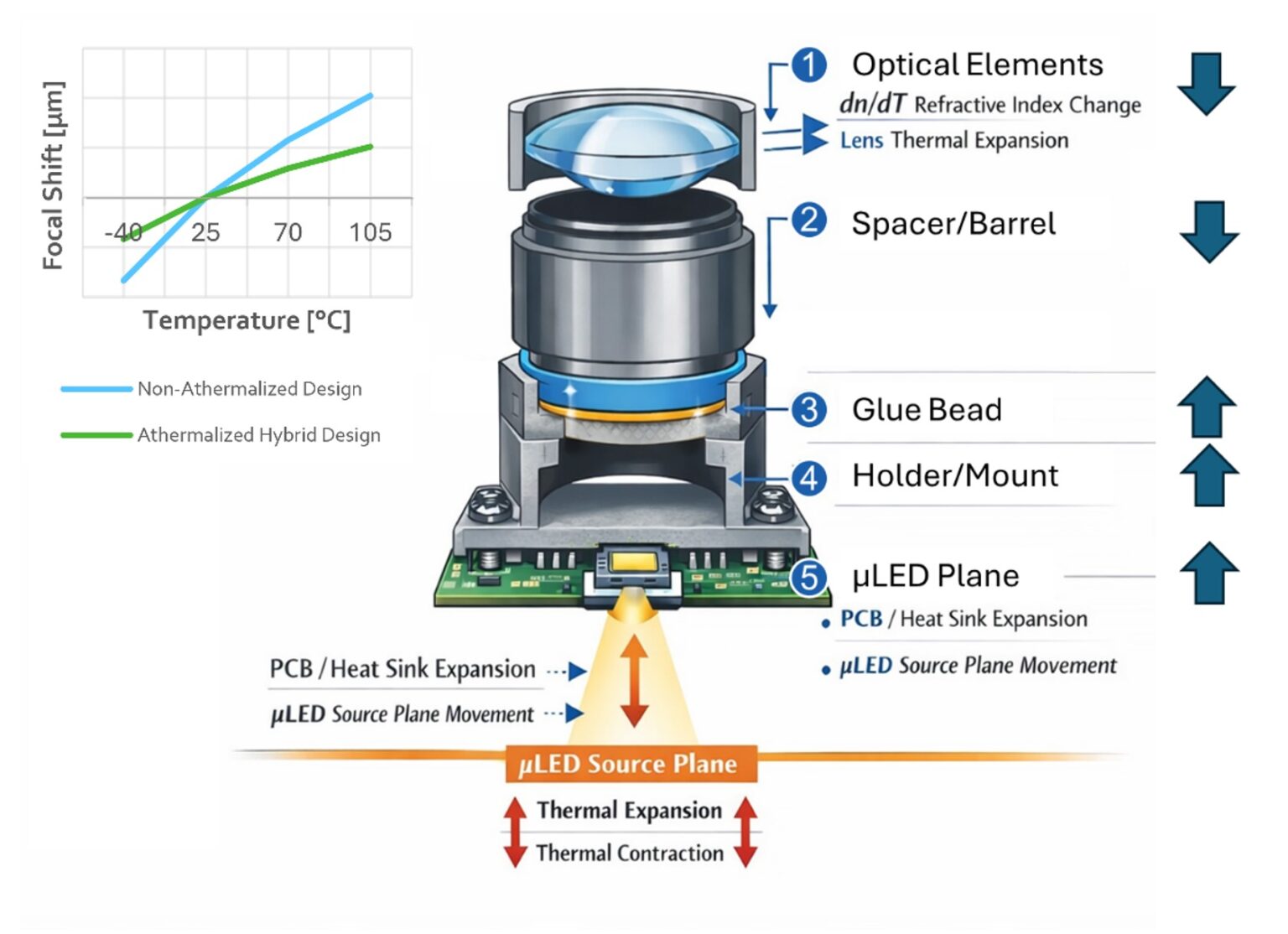
Everything in a camera changes size with temperature, and the lens elements also change refractive index. Plastic elements are hit twice. Their thermal expansion is roughly ten times that of optical glass (about 72 ppm/°C for PMMA against about 7 ppm/°C for BK7), and their refractive index changes with temperature far more than a glass index does.
Now put that next to the tolerance. As a first-order guide, depth of focus is about ±2 × f-number × pixel size. An F/2.0 lens on 3 µm pixels has roughly ±12 µm. Ten millimeters of aluminum between the sensor and the lens seat grows by about 23 µm over a 100 °C swing. The holder alone can spend the whole budget.
So does that mean all-glass? Not necessarily. Hybrid glass-plastic designs are often more thermally stable, because the difference in expansion between the materials gives the designer one more compensation variable. What matters is system-level compensation, not the stability of the lens alone.
Passive athermalization means designing the expansions and index changes to cancel each other:
- Passive compensation: account for the thermal expansion and dimensions of every optical and mechanical part, and use the lens holder as a compensator.
- Material and placement strategy: choose materials for the real operating range, and keep plastic elements away from heat sources.
- System-level validation: include the PCB, holder, and adhesive in the model, and make thermal MTF (image sharpness measured across temperature) an acceptance criterion.
Active refocusing exists, but a motor adds cost and a failure mode, and it is almost never justified in a fixed-focus production camera. We have shipped more than 120 million lenses into automotive and other applications where athermal behavior is critical, and we can athermalize the complete stack of lens, mount, PCBA, and adhesive, including module production if you want it built.
Customer scenario
If your supplier quotes MTF at room temperature only, ask for through-temperature MTF on the assembled module at your temperature extremes. A lens that holds focus in a steel test fixture can still drift in a plastic housing on your PCB.
Which Technology is the right one for a particular contamination?
We know there is no “one-size-fits-all”. Here is an example decision matrix we can use as a starting point. It is illustrative; your geometry and duty cycle will change some of the recommendations.
Illustrative decision matrix: ultrasonic cleaning, heating, and HP3 coating
| Evaluation item | Ultrasonic cleaning | Heating | HP3 coating |
|---|---|---|---|
| Primary strength | Non-contact surface excitation | Thermal melting and evaporation | Hydrophobic surface |
| Water removal | Strong | Good | Good |
| Dust removal | Strong | Weak | Limited |
| Light frost | Good | Strong | Weak |
| Thick ice | Good | Strong | Weak |
| Power draw | Low to moderate | High | Passive |
| BOM outlook | Medium to high, electronics-dependent | Low to medium | Low |
| Integration note | Needs resonance tuning | Needs thermal and power design | Adds a coating step |
Two patterns stand out. Nothing in the active columns replaces a hard, hydrophobic, low-static surface, and nothing passive removes ice. Most harsh-environment cameras end up with one passive stack plus one active method.
What do off-highway vehicles ask of a camera that passenger cars never do?

Off-highway machines in construction, mining, agriculture, and forestry share two traits: large blind areas and dirty work. Cameras exist to cover the first and have to survive the second.
The safety case is well documented. A NIOSH analysis of U.S. surface mining counted 54 fatal haul-truck-related accidents between January 2005 and June 2021 and called visibility one of the most significant contributing factors. In almost every case, the operator could not feasibly see the hazard. An earlier NIOSH evaluation of backing-safety devices on construction equipment reported that blind areas were a major factor in struck-by incidents that averaged 22 deaths a year in U.S. highway construction.
That same study recorded what happens to the cameras. On most trucks, cleaning the lens at the end of each shift was enough. On winter sanding and plow trucks, snow or road grime obscured the view after a few miles.
Agriculture adds dust on another scale. In tillage field tests during a very dry period, researchers found that a person detector often failed at 20 and 30 meters in heavy dust. Airborne dust is a perception problem. The part that settles on the lens is ours.
Here is how the suite maps onto OHV:
- Washdown: IP6K9K sealing plus HP3, because these machines are cleaned with hot, high-pressure water.
- Abrasion: HyperTuff™ or HyperCoat™ on any L1 that gets wiped by hand. Quartz dust and a glove amount to a scratch test.
- Winter operation: Machines with 12 or 24 V electrical systems usually have the watts, so direct L1 heating for fast clearing is realistic.
- Dry dust: anti-static treatment first, with ultrasonic cleaning for narrow-field cameras behind a window.
- Temperature and shock: athermalized design and boresight stabilization, so the calibration behind surround-view stitching or implement guidance holds from a cold start to a hot afternoon.
The challenge is mud
Wet, sticky soil is the contamination ultrasonic cleaning handles worst, and no coating sheds a centimeter of clay. For cameras mounted low on a machine, plan for a fluid or air wash, a protected mounting position, or both, and use the suite to stretch the interval between cleanings.
What changes when the camera rides on a robot instead of a truck?
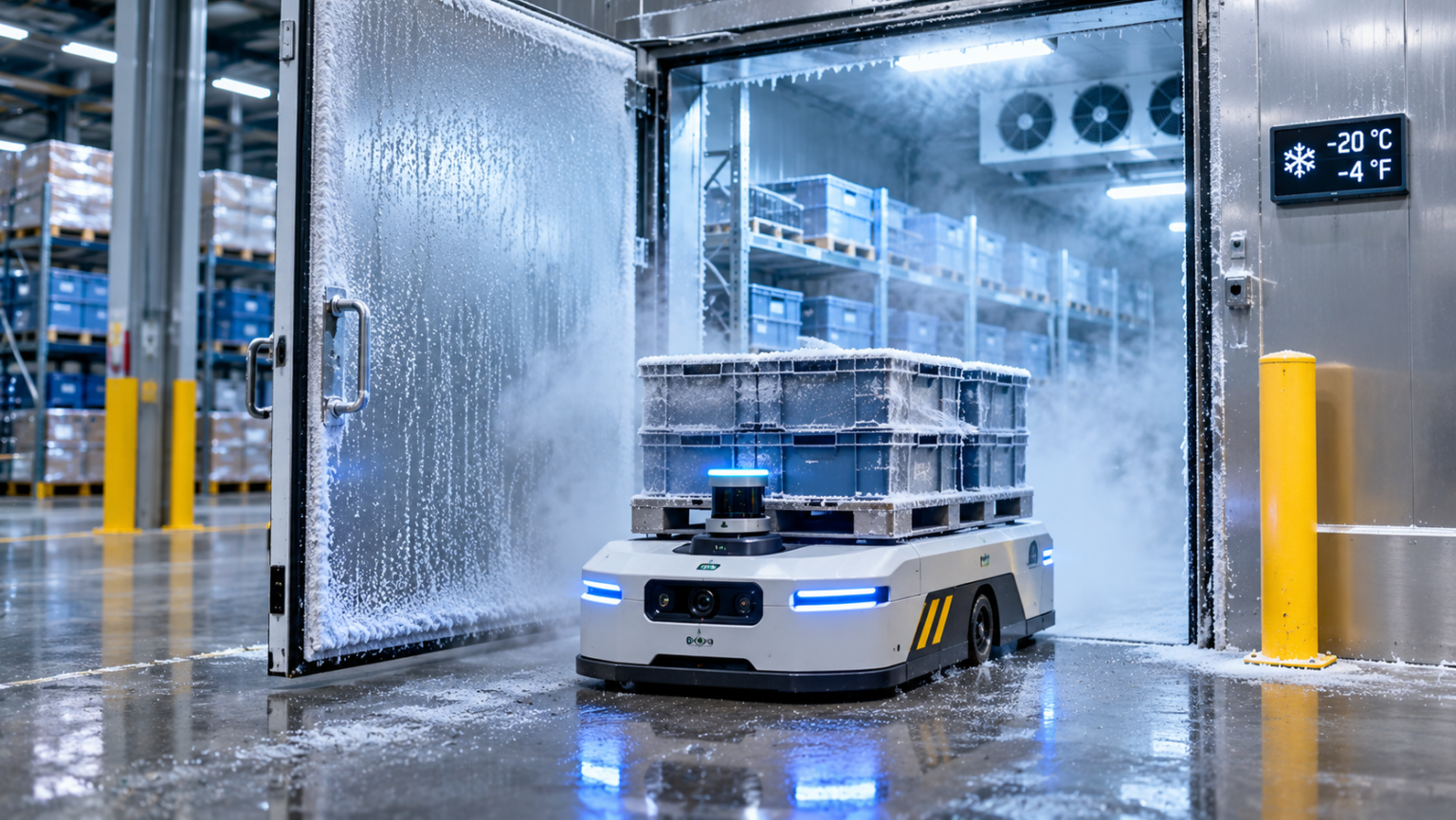
Three things. Nobody is there to wipe the lens. The power comes from a battery. And the software trusts the image.
A human operator looks around a droplet. A perception stack may not. A bead of water on one side of a stereo pair or a smear on a time-of-flight window can produce a false obstacle or a protective stop that takes the robot out of service until someone walks over. For a fleet operator, that walk is the cost.
Cold-chain logistics is a good example of an environment that looks benign and isn’t. Freezer-rated inventory robots are now specified down to -10 °F (about -23 °C), with heated LiDAR and condensation prevention between freezer and ambient zones as headline features. The physics is simple: a lens that has soaked at freezer temperature and rolls onto a humid loading dock is below the dew point, so water condenses on it, outside and sometimes inside.
That points to indirect barrel heating, which is the better method against internal condensation. On a battery, though, every watt competes with drive time. In our barrel-heating data, the lowest power setting cleared the ice with about 30% less energy than the highest. A robot that can wait two minutes at the freezer door should take the slow setting.
Outdoor robots for delivery, agriculture, and inspection add dust and splash at ankle height. Their narrow-field depth and time-of-flight cameras, behind small circular windows, are natural candidates for ultrasonic cleaning: no fluid tank to carry, under 5 W per transducer, and cleaning on demand.
One more point. Depth accuracy depends on calibration, and calibration depends on the optics staying where they were. For a stereo rig, passive athermalization and boresight stability decide whether the depth map is still right at -20 °C.
Customer scenario
If your robot’s cameras are calibrated once at the factory at room temperature, ask what focus and boresight do at both ends of your operating range. If nobody knows, that is the first test to run, before any coating decision.
Why is a security camera's worst enemy its own maintenance budget?
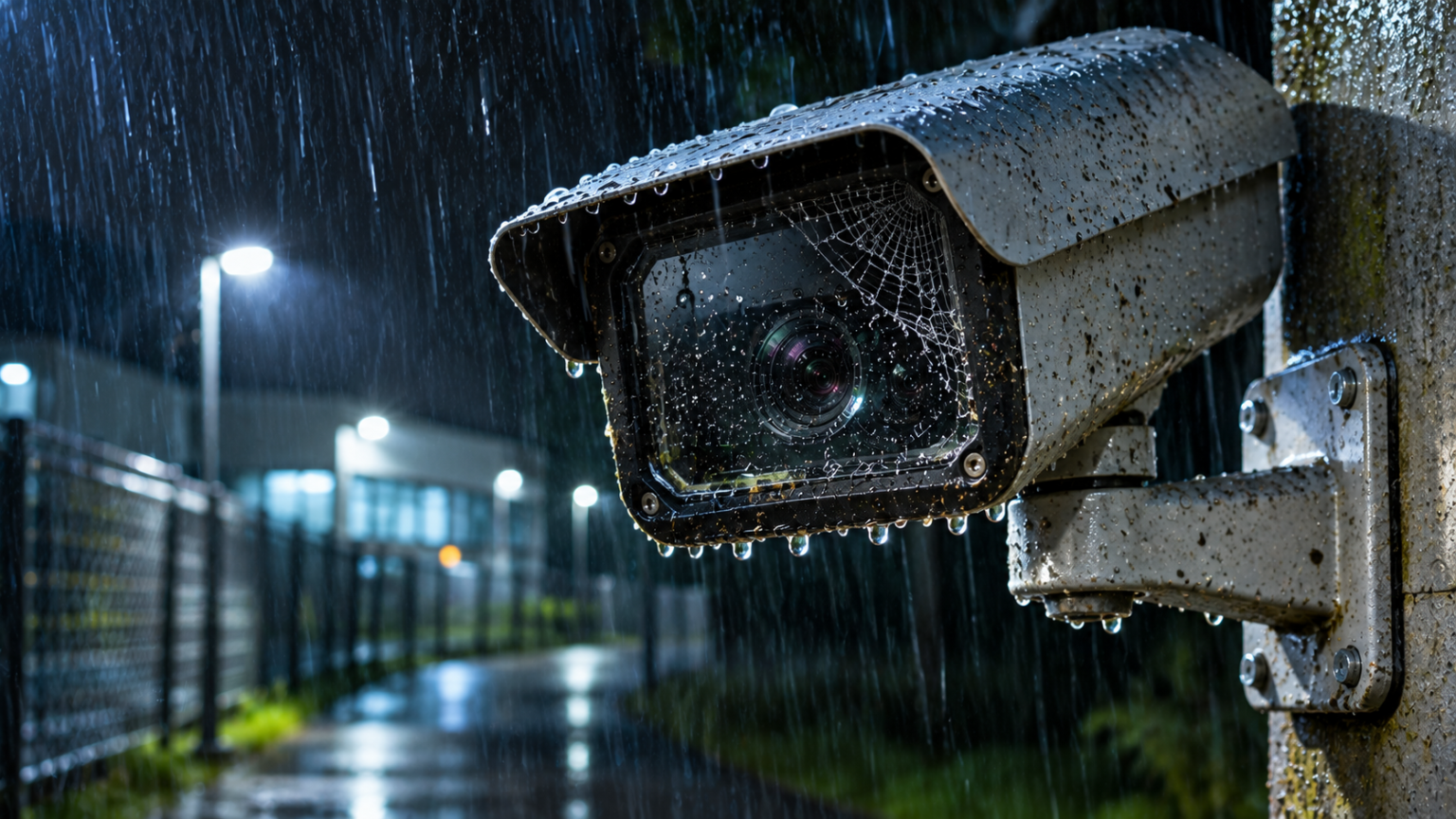
A security camera is installed once and expected to work for years, often on a pole that takes a lift to reach. Whatever lands on the optics stays until someone is paid to remove it.
Night performance is where dirt shows first. Most outdoor cameras carry their own infrared illumination, and industry guidance is consistent: dirt, dust, spider webs, and water drops on the front window reflect the camera’s own IR light back into the lens and can significantly degrade the image. Even light dust is enough. The camera isn’t broken. It’s blinded by its own light.
Cleaning has its own cost. Maintenance guides warn that paper towels, or compressed air held too close, can scratch the window, so each cleaning visit to a soft front surface can leave the next night’s image a little worse. A hard front surface changes that equation.
Vandal resistance is usually specified by IK rating under IEC 62262. IK10 corresponds to a 20 joule impact: a 5 kg mass dropped from 400 mm. Ask whether the rating covers the optical window as well as the housing, because the window is typically the weak point.
Here is how the suite maps onto security:
- Anti-static plus HP3 to slow the build-up of dust film and water spotting and to stretch the interval between service visits.
- HyperTuff™ or HyperCoat™ L1 where the lens is exposed without a dome: body-worn cameras, door stations, and compact bullet cameras that get wiped or struck.
- Passive athermalization for fixed-focus cameras that see direct sun and winter nights in the same housing. High-resolution sensors and fast low-light lenses have the smallest depth of focus, so they need it most.
- Heating where frost or condensation is routine, with barrel heating as the cost-effective default.
And a limit, because someone always asks. Anti-static and hydrophobic surfaces reduce what sticks. They don’t stop a spider from building across the housing. That still takes a brush.
What should you bring to your first conversation with a Sunex engineer?
Environmental protection is easiest to get right when it is on the first requirements list, not added after field returns. These inputs help, even if half are still open:
- Contamination types, ranked: dry dust, mud, rain, road salt, ice, oils, insects
- Operating and storage temperature range, and how fast the camera moves between extremes
- Power available for heating or cleaning, continuous or on demand
- Cleaning reality: who or what cleans the lens, how often, and with what
- Sealing and impact requirements (for example IP6K9K or an IK rating) and any wash chemistry
- Field of view, and whether a window in front of the lens is acceptable
- Sensor, pixel size, and f-number, so we can estimate the thermal focus budget
- Expected volumes and timeline
Don’t have all of it yet? That’s normal. Bring what you have.
Still have questions about protecting camera lenses from the environment?
What is the difference between direct lens heating and barrel heating?
Direct heating energizes a conductive coating on the front lens element and clears ice and external water fastest. In our test from -20 °C, it cleared the clear aperture in about one minute at 3 to 4 W. Barrel heating warms the whole lens, handles internal condensation better, and is more cost-effective, but it clears the front surface more slowly.
Can ultrasonic lens cleaning replace washer fluid?
For water, dust, fog, frost, snow, and ice on a suitable window, ultrasonic cleaning can eliminate or reduce fluid use, with target clearing times from 5 seconds for dust to 250 seconds for ice. Sticky mud remains difficult, and water can optionally be added to help remove solids.
How durable is a hydrophobic lens coating?
The Sunex HP3 coating measured a 113.9° contact angle before and 104.2° after a Taber-type abrasion test (CS-5 wheel, 1 kg, 3,000 passes). UV exposure reduced the contact angle by 8.6° to 24.0° depending on the lens, so verify on your lens geometry.
Do plastic or hybrid lenses hold focus over temperature?
They can. Plastics expand about ten times more than glass and their refractive index changes more with temperature, but a hybrid glass-plastic design gives the designer extra variables to cancel thermal effects. What matters is athermalizing the full system and verifying it with through-temperature MTF.
What does IP6K9K mean for a camera lens?
IP6K9K comes from ISO 20653 for road vehicles. 6K means dust-tight, and 9K means the part withstands high-pressure, high-temperature water jets, tested at about 80 °C and 8 to 10 MPa from a distance of 10 to 15 cm.
Which environmental protection technologies can be combined?
Most of them. A typical harsh-environment camera combines a passive stack (hardened front element, hydrophobic coating, anti-static treatment, sealing, and athermal design) with one active method, heating or ultrasonic cleaning, chosen for the dominant contamination and the available power.