
A lens that costs $8/unit can cost 10–100x more in total when you factor in redesign cycles, field failures, RMA costs, and missed production ramps. The real cost of the wrong lens is measured in program delays and customer returns — not unit price.
This article breaks down Total Cost of Ownership (TCO) across three sourcing channels — internet/commodity, catalog intermediaries, and direct OEM partnerships — and shows why OEM-designed lenses consistently deliver lower TCO even when the unit price is higher.
When procurement teams evaluate optical components, unit price is the number that fits most naturally into a spreadsheet cell. It is comparable, auditable, and easy to defend. But in mission-critical imaging programs — whether the application is an automotive driver-monitoring camera, a surgical endoscope, or a logistics robot navigating a warehouse floor — unit price is only a fraction of what a wrong choice can cost over the program lifetime.
In this article, we take a deeper look at the following content:
- Why is unit price a misleading metric when evaluating camera lenses?
- What is the total cost of ownership (TCO) of an imaging lens over a product lifetime?
- How does sourcing from internet platforms vs. OEM partners affect lens reliability?
- Automotive: Where Optics Meet Functional Safety
- Robotics: Algorithm Performance Depends on Optical Consistency
- Medical: Regulatory Cliffs Are Real
- What are the hidden costs of using commodity M12 lenses in production systems?
- How do you calculate the real cost of a lens redesign mid-program?
- Technical Depth & Design Capability
- Manufacturing Process Control
- Lifecycle & Supply Commitment
- Commercial Competitiveness
- Procurement Checklist: Questions to Ask Before Committing
1. Why is unit price a misleading metric when evaluating camera lenses?
The three primary sourcing channels — internet marketplaces, catalog intermediaries, and direct OEM manufacturers — each serve a legitimate role. The problem arises when the wrong channel is used at the wrong project stage, or when early decisions are not recognized as architectural commitments with long-term consequences.
A $2 lens purchased on an internet marketplace and a $40–$80 lens from a specialized OEM may appear superficially similar — same mount, similar field of view, comparable F/# — but they are fundamentally different products with fundamentally different risk profiles.
RISK SIGNAL Purchasing decisions made during PoC or early sampling are rarely renegotiated before production ramp. Teams that anchor to a low-cost catalog part during exploration often find themselves locked in — contractually or practically — when the costs of switching are highest.
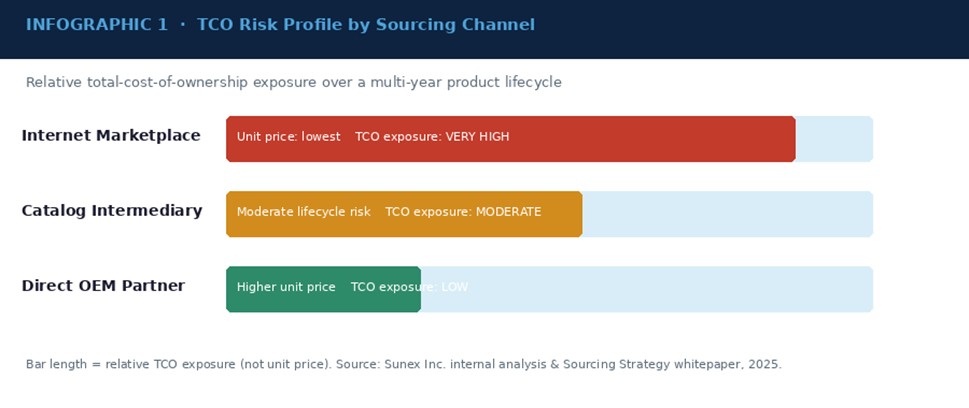
Graphic 1 – TCO Risk Profile by Sourcing Channel: bar length represents relative lifecycle cost exposure, not unit price.
2. What is the total cost of ownership (TCO) of an imaging lens over a product lifetime?
TCO is not a single event — it is a pattern of costs that accumulate across the product development lifecycle. Understanding when different cost categories emerge is as important as understanding how large they might be.
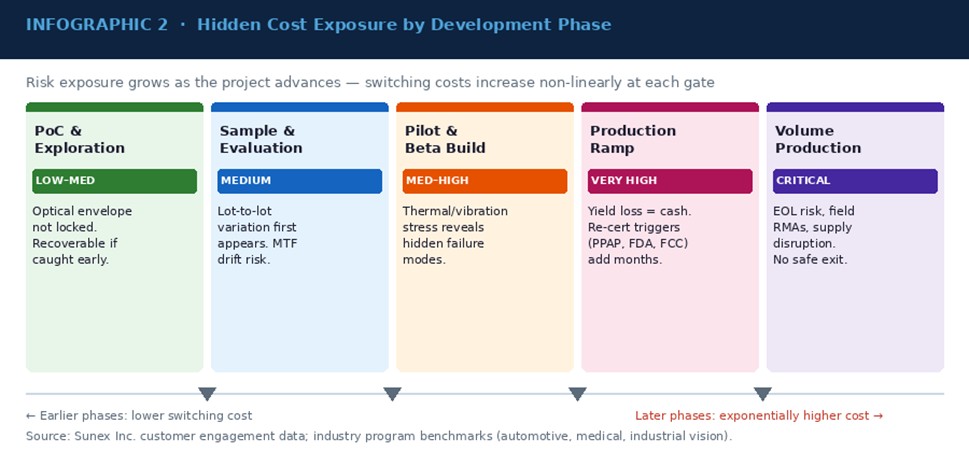
Graphic 2 – Hidden Cost Exposure by Development Phase: risk exposure grows non-linearly as the project advances through each gate.
THE HIDDEN COST CATEGORIES
Each phase introduces distinct costs that do not appear on the lens purchase order:
- Engineering re-work hours — when a lens fails a qualification gate, the team reassigns design resources. In programs with 5–15 optical/system engineers, even two months of re-work represents significant sunk cost.
- Re-qualification and re-certification — automotive programs (PPAP, FMEA updates), medical devices (FDA 510(k) submissions, IEC 60601 re-testing), and CE/FCC-class products face regulatory timelines measured in months, not weeks.
- Yield loss at scale — a 2% yield reduction on a 100,000 unit/year production run, with a camera module value of even $150, represents $300,000 in annual write-offs.
- Field RMAs and warranty — for deployed systems, recall costs, field service labor, and reputational damage vastly exceed the value of the defective optic.
- Supply discontinuity — an unplanned end-of-life event in volume production can force emergency redesign at exactly the moment the organization has no capacity to absorb it.
KEY INSIGHT The cost of switching optical suppliers grows non-linearly as a project advances. Switching during PoC might cost a few weeks. Switching during production ramp can cost $500K–$2M in re-qualification, re-tooling, and delay — for a component with a unit price of $15.
3. How does sourcing from internet platforms vs. OEM partners affect lens reliability?
The magnitude of TCO exposure is not uniform across industries. Regulatory frameworks, safety criticality, deployment environment, and volume scale all determine how severely a bad sourcing decision compounds over time.
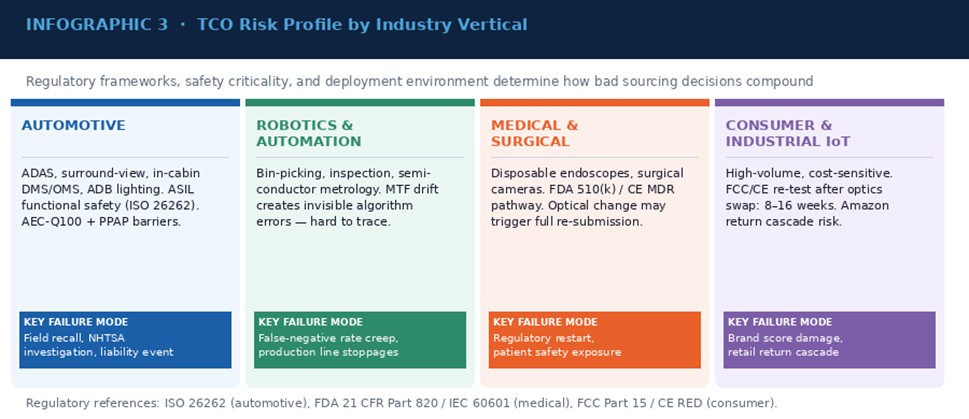
Graphic 3 – TCO Risk by Industry Vertical: automotive, robotics, medical, and consumer/industrial IoT each carry distinct failure modes and regulatory barriers.
AUTOMOTIVE: WHERE OPTICS MEET FUNCTIONAL SAFETY
Modern automotive cameras — for surround-view, ADAS, in-cabin driver monitoring, and high-definition ADB lighting — are safety-critical systems governed by ISO 26262 functional safety frameworks. An optic that introduces unexpected image artifacts, field of view drift under temperature cycling (−40°C to +105°C), or MTF degradation at the image periphery can compromise the detection capability of the downstream vision algorithm. Under ASIL-B or ASIL-D classification, such a failure is not a field quality issue — it is a liability event.
PPAP documentation for automotive programs requires a complete optical and mechanical process capability study. Switching lenses after PPAP sign-off forces a PPAP re-submission — a process that typically adds 3–6 months to any ramp schedule.
ROBOTICS: ALGORITHM PERFORMANCE DEPENDS ON OPTICAL CONSISTENCY
Machine vision and robotic guidance algorithms are trained and validated on a specific imaging pipeline. When lens MTF, distortion map, or shading profile changes between production lots — subtly, below what incoming inspection catches — the algorithm may begin producing errors that are nearly impossible to trace back to the optics without controlled lot-isolation testing. This is one of the most insidious TCO risks in robotics: the failure mode is invisible until it manifests as a production quality escape downstream.
MEDICAL: REGULATORY CLIFFS ARE REAL
For disposable endoscopes and surgical imaging systems, the FDA 510(k) substantial equivalence pathway or CE MDR technical file review is the program’s most valuable asset. Any modification to the optical element — even a “drop-in equivalent” from a different supplier — may trigger a new submission. The cost of an unplanned 510(k) resubmission, including clinical and engineering preparation, typically runs into six figures and adds 6 to 18 months of delay.
4. What are the hidden costs of using commodity M12 lenses in production systems?
A practical TCO model for lens sourcing does not require actuarial precision — it requires the intellectual honesty to put plausible numbers on categories that typically go unstated in procurement reviews.
Cost Category | Internet Marketplace | Catalog Intermediary | Direct OEM Partner |
Unit price (optic only) | Lowest | Moderate | Moderate–Higher |
Engineering re-work risk | Very High ▲▲▲ | Moderate ▲▲ | Low ▲ |
Lot-to-lot variation | Uncontrolled | Partially controlled | Process-controlled |
Re-qualification cost | High ▲▲▲ | Moderate ▲▲ | Minimal (change control) |
EOL / discontinuity risk | Very High ▲▲▲ | High (upstream-dependent) | Low (lifecycle committed) |
Field RMA / warranty cost | High ▲▲▲ | Moderate ▲▲ | Lowest ▲ |
Engineering & OQC support | None | Limited | Full (design + process) |
Supply continuity commitment | None | Partial | Contractual / roadmap-aligned |
Risk ratings are qualitative assessments based on documented program outcomes. Source: Sunex Inc. internal analysis; Sunex M12 Sourcing Strategy whitepaper, 2025.
A THOUGHT EXPERIMENT FOR PROCUREMENT TEAMS
Before approving a sourcing decision based primarily on unit price, apply this multiplier test:
- What is the engineering re-work cost if this lens fails qualification at the pilot stage? (Estimate in engineering-weeks × fully-loaded labor rate)
- What is the regulatory re-certification cost if the lens must be changed after design freeze?
- What is one month of production delay worth in deferred revenue?
- What is the field RMA and warranty cost per unit at a projected 1–3% field failure rate on volume shipments?
- What is the cost of an unplanned EOL event during peak production?
KEY INSIGHT In most programs, if any two of these events materialize, the cost exceeds the lifetime savings on unit price from the cheaper lens — typically by an order of magnitude. This is not pessimism; it is the observed pattern across programs that have retrospectively applied TCO analysis.
5. How do you calculate the real cost of a lens redesign mid-program?
Sophisticated procurement teams have increasingly moved toward multi-criteria supplier evaluation frameworks. For optical components in mission-critical imaging systems, the following dimensions deserve equal or greater weighting than unit price:
TECHNICAL DEPTH & DESIGN CAPABILITY
- Does the supplier own their optical designs, or are they reselling third-party designs?
- Can they provide MTF data, distortion maps, and relative illumination curves — traceable to their own test equipment?
- Can they co-develop custom specifications to match your sensor’s CRA profile, active area, and operating environment?
- Do they have experience with athermalization, RGBIR co-registration, active alignment, or other advanced optomechanical capabilities relevant to your application?
MANUFACTURING PROCESS CONTROL
- What statistical process control (SPC) methods are applied to key optical parameters?
- Is binning available for yield-critical programs?
- What change-control procedures govern glass substitution, coating recipe updates, or assembly process modifications?
- Is traceability to production lot documented and retrievable?
LIFECYCLE & SUPPLY COMMITMENT
- What is the supplier’s published EOL policy, and how much advance notice do they commit to?
- Will the supplier contractually align their product lifecycle to your program roadmap?
- Are alternative or second-source options identified in advance, rather than reactively?
COMMERCIAL COMPETITIVENESS
The argument for OEM partnership is not an argument for paying premium prices without accountability. Commercially competitive OEM manufacturers can and should be held to pricing that reflects their cost structure, volume scaling, and the shared value of a long-term partnership. The goal is not to choose between cost efficiency and quality — it is to identify suppliers who deliver both, with engineering depth to back it up.
KEY INSIGHT The right question is not “which lens is cheapest?” but “which supplier will help us ship on time, at quality, and keep us in supply for the life of our product?” Those are different questions that often have different answers.
6. Procurement Checklist: Questions to Ask Before Committing
☐ | Optical performance (MTF, distortion, shading) validated across full operating temperature and vibration range — not just ambient. |
☐ | Lot-to-lot traceability and change-control procedures documented and reviewed with the supplier. |
☐ | Supplier owns the optical design (not a reseller); design modification is possible without third-party dependency. |
☐ | EOL policy and advance-notice commitment reviewed and matched to the product lifecycle. |
☐ | Yield, binning, and active alignment options evaluated and costed for the projected production volume. |
☐ | Regulatory certification plan (automotive PPAP, FDA 510(k), CE MDR) reviewed for optics change-control implications. |
☐ | Direct engineering support available for qualification, failure analysis, and field investigation. |
☐ | Supply continuity scenario (forecast variability, allocation risk, safety stock) modeled for peak production. |
☐ | TCO model — including re-qualification, yield loss, and RMA exposure — presented alongside unit price in sourcing approval. |
Conclusion: The Right Partner, Not Just the Cheapest Part
The lens is rarely the most expensive component in an imaging system. But in program after program — in automotive, robotics, medical, and industrial vision applications — the lens has proven to be the component whose sourcing decision carries the greatest TCO leverage. A well-specified, process-controlled, lifecycle-committed optic from a capable OEM manufacturer reduces risk across every dimension of the project: engineering schedule, qualification, yield, field performance, and supply continuity.
Making a sourcing decision based solely on the cheapest unit price is not a conservative choice — it is a high-risk one. The risks are simply deferred, compounded, and revealed at the worst possible moment: during production ramp, at a regulatory milestone, or after deployment.
The recommendation is to insist on a supplier who is commercially competitive and technically capable — one with deep optical and manufacturing engineering experience, a documented quality system, and the organizational commitment to support your program through its full lifecycle. That combination is not a premium. It is the most cost-effective sourcing decision your program can make.
Sources & Further Reading
- Sunex Inc. Choosing the Right Sourcing Strategy for M12 Lenses. Sunex Technology & Resource Hub, September 2025. sunex.com/2025/09/22/choosing-the-right-sourcing-strategy-for-m12-lenses/
- ISO 26262:2018 — Road vehicles: Functional safety. International Organization for Standardization. iso.org/standard/68383.html
- U.S. FDA. Deciding When to Submit a 510(k) for a Change to an Existing Device. FDA Guidance, October 2017. fda.gov
- Automotive Industry Action Group (AIAG). Production Part Approval Process (PPAP), 4th Edition. AIAG, 2006.
- IEC 60601-1:2005+AMD1:2012 — Medical electrical equipment: General requirements for basic safety and essential performance. IEC.
- Embedded Vision Alliance. Embedded Vision Market Study, 2024. embedded-vision.com
- Sunex Inc. RGBIR Lens Technology for Automotive In-Cabin Monitoring. Sunex Technology & Resource Hub, 2025. sunex.com/products/rgbir/