
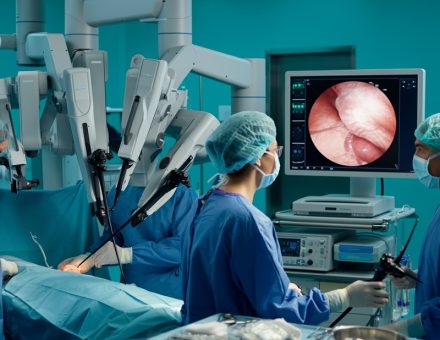
Chip-level camera modules offer fast time-to-market for single-use endoscopes — but custom optical systems deliver superior image quality, autofocus capability, and clinical differentiation that chip-on-tip modules cannot match. The right choice depends on your resolution requirements, sterilization constraints, and whether you are building a commodity device or a premium clinical platform.
This article compares both approaches across optical performance, DFM readiness, regulatory compatibility, and total cost of ownership for medical device OEMs.
Custom Optics for Medical Devices offer a Flexible Alternative to Chip-level Cameras
As the market for disposable endoscopes, catheter-based imaging, and minimally invasive diagnostic devices grows, medical OEMs face a key architectural decision: use a fully integrated sensor module like Omnivision’s CameraCubeChip®, or pursue a custom camera system where image quality, flexibility, and system integration are optimized for the end application.
While integrated modules offer simplicity and ultra-compact size, they are not always the best fit, especially when device differentiation, superior image performance, or tight system integration is required. In these scenarios, Sunex’s custom optical and sensor module solutions present a powerful alternative.
What is the difference between a chip-level camera module and a custom optical system for endoscopes?
Chip-level integrated technology delivers a compact, ready-to-use module by embedding a CMOS sensor, fixed lens, and packaging into a single unit. This approach is well-suited to basic visualization tasks, especially where cost and simplicity dominate. However, this integration comes at the cost of flexibility:
- Fixed optics limit field of view, depth of field, and image plane tuning.
- No autofocus capability for applications with variable working distances.
- Limited sensor options, especially for newer sensors with specialized features (e.g., global shutter, large pixel size, or spectral sensitivity).
For advanced medical procedures—such as precision-guided catheter navigation, robotic-assisted surgery, or high-resolution disposable endoscopes—these trade-offs may outweigh the convenience of a one-size-fits-all module.
Sunex: Tailored Imaging Systems Designed for Performance, Size, and Cost
Sunex specializes in designing and manufacturing custom optical systems, miniature lenses, and complete camera modules for medical imaging applications, including disposable (aka single-use) endoscopes. Our expertise enables medical device companies to develop systems tailored to specific clinical tasks and imaging environments.
Key Advantages of Sunex’s Custom Approach:
- Application-Specific Optics
Custom-designed lenses to achieve your desired FOV, working distance, MTF, distortion characteristics, and mechanical envelope. - Tunable Autofocus Options
Possible integration of tunable lens elements (e.g., electrically tunable liquid lenses) enables autofocus capability in miniature imaging systems—ideal for multi-depth procedures or variable tissue distances. - Sensor & PCB Flexibility
Support for any CMOS sensor of your choice—no lock-in to predefined imaging specs.
Sunex also offers custom PCB design and manufacturing, including image sensor integration for bare die and packaged CMOS sensors, power delivery, and connectivity. - Advanced Optical Alignment
Active alignment between the lens and sensor ensures optimal focus, centering, angular performance, and the smallest part-to-part variance, which is particularly critical for small-pixel sensors, high-resolution systems, and large-volume applications. - Feasibility Studies & System Optimization
Early-stage design feasibility services, optical simulations, and system-level analysis help de-risk development and accelerate product timelines. - Sterilization-Ready Materials
Lens and housing materials are selected in accordance with the customer’s requirements for sterilization and approval processes commonly used for single-use medical devices. - Scalable Manufacturing
Whether you need prototypes for clinical trials or full-scale production for disposable scope lines, Sunex’s vertically integrated capabilities can scale with your business from early prototypes to high-volume series production.

When does a disposable endoscope benefit from custom optics vs. a chip-level module?
There are many different indications, devices, and procedures in the medical field. Even though they all have their specific requirements, they all benfit from a custom appraoch to teh optical system if one or more of the follwoing is required:
- High-resolution and wide-angle disposable endoscopes requiring low distortion and superior edge-to-edge sharpness.
- Large Depth-of-Field (DOF) imaging where autofocus is needed to maintain clarity at variable object distances.
- Dual-imager or Stereo vision systems, where precise calibration and alignment between channels are mandatory.
- Low-light or IR-capable applications requiring optimized optics and sensor pairing.
How does Sunex scale from prototype to high-volume production for medical camera modules?
Fully integrated chip-level camera modules provide a valuable solution for many basic disposable imaging tasks, especially where space and cost constraints are paramount.
However, when performance matters, whether it’s higher image quality, autofocus capability, robustness, or system-specific sensor selection, a custom camera module built by Sunex offers differentiation by meeting the performance, size, and commercial objectives required to make the end-customer successful in their domain.
From lens design and simulation to sensor integration, active alignment, tunable focus implementation, and custom PCB layout, Sunex provides a comprehensive pathway from concept to volume production, delivering imaging systems that meet the demands of next-generation medical devices.
Click image to download the Sunex Medical Brochure

Disclaimer:
CameraCubeChip® is a registered trademark of Omnivision Technologies, Inc. All other trademarks are the property of their respective owners. Sunex makes no claim of endorsement or affiliation.