
How do you Choose the Right Lens Design or Your HD Headlamp Program
Aspherical lens surfaces correct optical aberrations that spherical elements cannot — in fewer elements, with shorter total track length. Plastic aspheres are the lowest-cost path at volume, but they require careful athermal design to perform across the automotive operating temperature range. Glass aspheres (PGM – Precision Glass Molding) make more sense for low-volume or thermally demanding programs. Hybrid designs combining glass and plastic are often the optimum. The right answer depends on volume, temperature profile, beam geometry, and — critically — whether your supplier is fluent in all four design forms or is steering you toward whatever they happen to make.
Why Do µLED Headlamps Demand More Optical Complexity — and What Does That Mean for Lens Design?
We’ve had this conversation with Tier 1 lighting engineers more times than we can count over the past years: the optical system that worked fine for matrix LED is genuinely not adequate for µLED and pixel lighting. The reason is simple. µLED arrays pack light-emitting die at extremely high spatial density, and the goal is to project each pixel’s output with controlled angular precision — shaping far-field beam patterns with pixel-level addressability for glare-free high beam, dynamic cornering light, and eventually full adaptive driving beam (ADB) functions. This requires systems that combine imaging and projection optics.
Designing a lens for a system with a µLED source is an exponentially larger challenge than projecting a single high-wattage LED. The beam shaping requirements are stricter. The tolerances on aberration correction are tighter. And the package constraints in modern headlamp assemblies are, if anything, getting worse, not better.
THE PHYSICS Spherical aberration, coma, and field curvature all degrade the sharpness and efficiency of a µLED projection system. Spherical lenses correct these aberrations sequentially — each surface addresses part of the problem, which means you need more surfaces, more elements, and more total track length (TTL). An aspherical surface can address multiple aberration types simultaneously, which is why a single aspheric element can do the corrective work of roughly two spherical elements. Fewer elements means shorter TTL, lower transmission losses, and lighter assemblies — all of which are constrained in an automotive headlamp.
This isn’t a theoretical benefit. It’s measurable. Side-by-side ray trace comparisons between all-spherical and aspheric designs for the same performance specification consistently show two to three fewer elements in the aspheric design, with equal or superior MTF at the field edge. That tradeoff is where the practical design conversation starts.
What Makes Plastic Injection-Molded Aspheres So Economically Attractive — and Where Do They Present a Challenge?
Here’s the thing about plastic aspheres that many engineers outside the optics supply chain don’t initially appreciate: once you have the injection mold tooled, an aspherical surface costs exactly the same per unit to reproduce as a spherical one. The complexity of the surface profile is captured in the tool. The marginal unit cost is zero.
Glass aspheres manufactured via precision glass molding (PGM) don’t work that way. Each glass surface adds significant cost at both the tooling and per-unit level because PGM requires forming heated glass under precisely controlled pressure and temperature — a slower, more material-intensive process than injection molding. And traditional glass asphere grinding/polishing is slower still.
The economic case for plastic, then, is strong — at volume. Tooling for a plastic aspherical mold can run high, depending on surface complexity and tolerance requirements. At annual volumes roughly 50,000 to 100,000 units per year or larger, that investment amortizes quickly. Below that threshold, the NRE risk may favor glass.
Plastic also opens a design dimension that glass aspheres rarely offer: non-rotationally-symmetric surfaces. Rectangular beam footprints, freeform profiles for ADB pixel shaping, non-circular clear apertures, complex flange geometries — these are achievable in plastic injection molding in ways that spherical glass simply cannot match. For lighting programs where the visual design aspects (OEM brand recognition) drive many of the decisions, this matters a great deal.
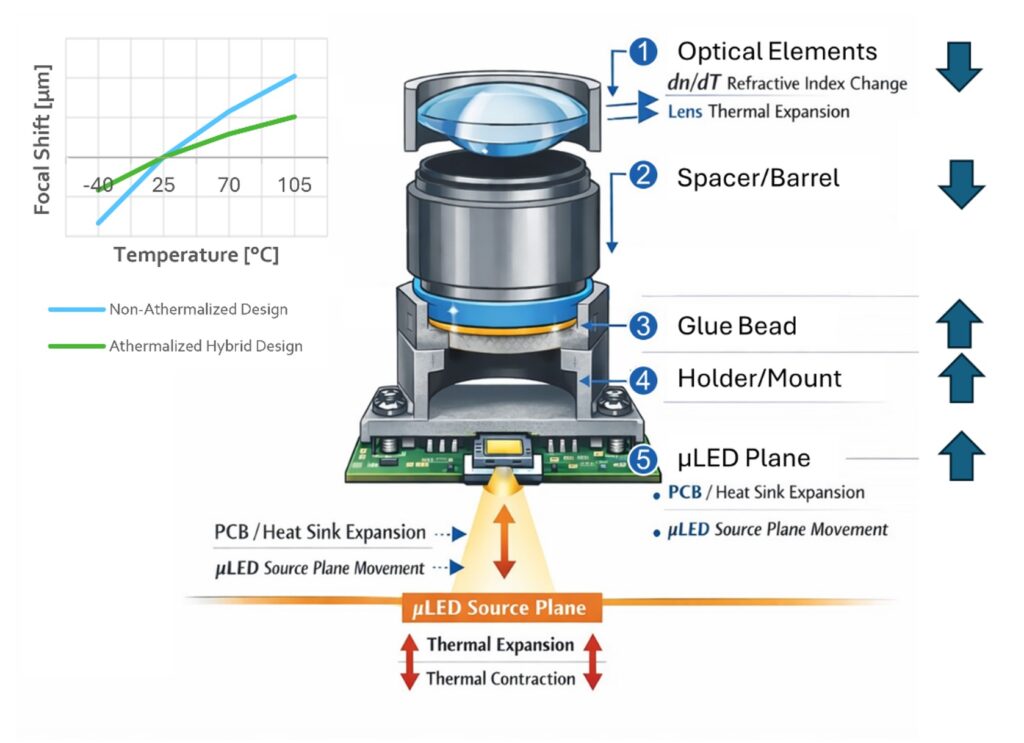
THE THERMAL CHALLENGE Plastic aspheres have a critical challenge: thermal sensitivity. For example, PMMA — a common optical plastic in lighting — has a coefficient of thermal expansion (CTE) of approximately 70 ppm/°C, versus roughly 7 ppm/°C for typical glass. The refractive index of plastic also changes with temperature. In a headlamp assembly operating from −40°C to +95°C continuously (with stack temperatures potentially reaching 150°C near LED drivers), an uncompensated plastic element will shift focus enough to meaningfully degrade MTF. This is not a minor effect. Ignoring it will significantly impact the overall performance of the headlamp system.
How Do You Actually Solve the Thermal Problem in a Plastic Aspheric Design?
Athermalization — designing an optical system so that its performance is stable across a wide temperature range — is one of the genuinely hard engineering problems in automotive optics. The challenge with plastic aspheres is that both the geometry (CTE-driven dimensional change) and the optical properties (dn/dT, the change in refractive index with temperature) are working against you simultaneously.
There are three main considerations, and they’re not mutually exclusive:
Passive Compensation:
Consider CTE and dimensions of all optical and mechanical lens components.
Use the lens holder as a compensator for expansion.Placement and Material Strategy:
Position plastic elements away from high-temperature zones near the µLED source and choose materials in support of the operating temperature range.System-level Validation:
Review system CTE (PCB, holder, glue, etc.) and optimize and consider Thermal-MTF as an acceptance criterion.
Active mechanical focus compensation — moving elements under thermal control — exists in theory but is almost never cost-justified in a production headlamp. Passive design is the answer.
THE EXPERIENCE THAT MATTERS We have delivered more than 120 million lenses worldwide with no field returns attributable to athermal design failure. That number reflects 20 years of production experience across programs that span the full automotive temperature range. Athermal hybrid design is a solvable problem — but it requires design experience that can only be validated by production data, not simulation curves alone.
Plastic, Glass, or Hybrid — Which Design Form Is Right for Your Program?
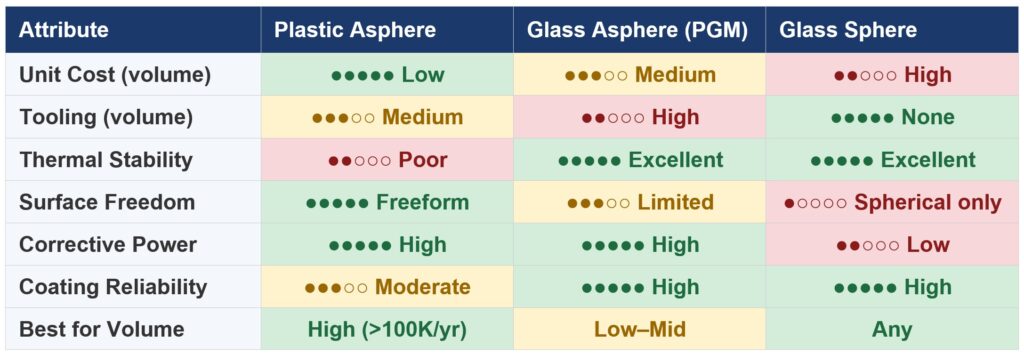
The honest answer is: it depends on four variables. Program Volume, temperature, performance requirements, and mechanical envelope. Here’s a direct comparison across the key attributes:
And here’s how those variables map to a design form recommendation:
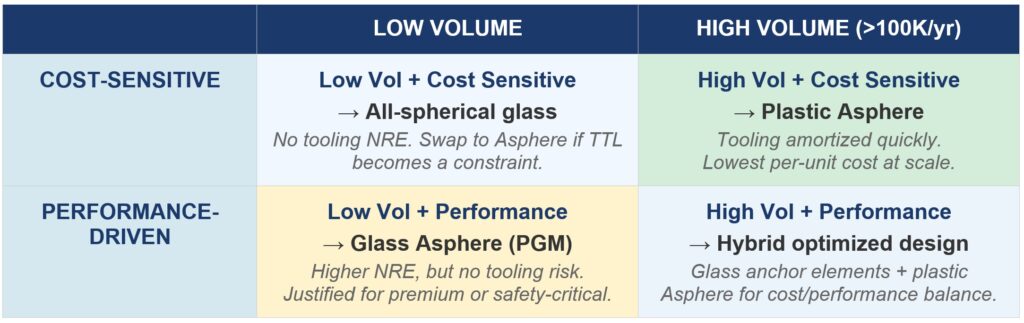
A note on the hybrid cell: hybrid designs are not simply ‘mixed.’ They require active optimization of which function each element performs. The glass elements carry the thermal stability and coating burden; the plastic elements carry the aspherical correction and beam shaping burden. Getting the division of labor right is where supplier experience matters.
Why Does Supplier Design-Form Agnosticism Matter More Than Any Single Technical Choice?
This is the part of the conversation that Tier 1 procurement and engineering teams sometimes underweight, and we try to be direct about it because it has practical program consequences.
A lens supplier whose manufacturing capability is limited to a single design form — say, only plastic injection molding, or only spherical glass grinding — will, without exception, find ways to make that form fit your requirements. It’s not usually bad faith. It’s that human beings optimize for what they know, and sales engineers sell what they have. You’ll get a design that works in their process. It may or may not be the optimal design for your program.
The analogy we use: imagine specifying a machined mechanical part from a shop that only knows CNC milling. They’ll quote you a milling solution. They’ll never say ‘casting would be cheaper and better here’ — because they don’t cast. You only hear that from a shop that does both.
The same logic applies to optics. A supplier fluent in all four design forms — spherical glass, aspheric glass via PGM, plastic aspheres, and hybrid combinations — can let the requirements drive the solution. Volume too low to amortize plastic tooling? They’ll say so, and quote PGM glass instead. Temperature profile too aggressive for plastic? They’ll design the hybrid to minimize plastic thermal exposure, or recommend glass aspheres. Beam geometry inherently non-symmetric? They’ll go freeform plastic, because that’s the only cost-effective path.
TRY THIS Ask any prospective supplier to walk you through a program where they recommended against their primary manufacturing process because a different design form was better for the customer. If they can’t cite a specific example, you have your answer about their agnosticism.
What Should Every Lighting Engineer Ask Before Specifying a Lens for an ADB or HD Headlamp Program?
Before you write a lens specification — or before you accept one from a supplier — these are the questions worth working through:
- What is my annual volume forecast — and how firm is it?
Tooling investment for plastic or glass aspheres can run high. If volume confidence is low, that cost may not amortize. - What is the operating temperature?
Surface temperatures of µLEDs can be high, and operating temperatures in vehicles often depend on the installation location and can exceed 105°C. Document this before specifying any plastic element. - Is my beam pattern rotationally symmetric?
Light patterns are often non-rotationally symmetric, or the OEM requests a specific shape (e.g., rectangular) for the outcoupling lens. Only plastic freeforms and non-rotationally-symmetric aspheres can shape these — spherical glass cannot. - What is my total track length (TTL) and mechanical envelope?
One well-placed aspheric element can substitute for two spherical elements. If you’re constrained on package size, aspheres are frequently the only path forward. - Does my supplier have athermal hybrid designs in automotive production?
Ask for production data — not simulation curves. Any competent design house can model athermal behavior; delivering it at 120M units is a different matter. - Can they provide MTF vs. temperature data — not just nominal MTF?
Nominal MTF tells you about room-temperature bench performance. What matters for a production headlamp is whether MTF holds across the −40°C to +95°C operating range, and this counts at the system level, not just the lens alone. - Is your supplier optimizing for your requirements or steering toward their process?
A partner constrained to a single design form — only plastic, only spherical, only PGM — will rationalize that form for your program. The solution should follow the requirements, not the supplier’s equipment.
ONE MORE THING If the answer to the last question is genuinely unclear after a supplier conversation — that’s your answer. A supplier who knows how to design for your requirements can explain clearly why they’re recommending a specific form. Uncertainty on that question is a signal, not a gap to paper over.
What Are the Key Takeaways for Engineers Specifying Lenses in Next-Generation Headlamp Systems?
We’ve covered a lot of ground. Here’s the condensed version:
- One well-designed aspherical element can substitute for two spherical elements in corrective power. If you’re constrained on TTL — and most modern headlamp programs are — aspherical surfaces are frequently not optional.
- Plastic aspheres are the most cost-effective design form at volume, but athermal design is non-negotiable. Skip it and you will have field issues.
- Glass aspheres via PGM are the right choice for low-volume, high-performance, or thermally demanding programs where plastic aspheres won’t apply.
- Hybrid designs combining glass anchor elements and plastic aspheres often represent the optimal cost/performance balance for high-volume automotive production — but require more design sophistication than an all-glass approach.
- Design form agnosticism in your supplier is a genuine program risk mitigant. The best lighting system comes from a partner with no design-form bias — just engineering rigor applied to your specific requirements.
The shift from matrix LED to µLED lighting is real, it’s happening now across multiple OEM programs, and it is raising the optical complexity bar for everyone in the supply chain. The lens decisions made today will show up in production headlamps in the future!
Design it right the first time.
Your next steps:
Talk to a Sunex optical engineer about the design-form tradeoffs for your specific headlamp program — including volume, temperature profile, and beam geometry constraints.
→ Contact a Sunex Engineer to discuss your program requirements: sunex.com/contact
→ Watch our YouTube Knowledge Library for optical design tutorials and application notes
→ Read Part 1: How µLED Arrays Are Reshaping Automotive Headlamp Optical Architecture (DVN Shanghai 2025)