
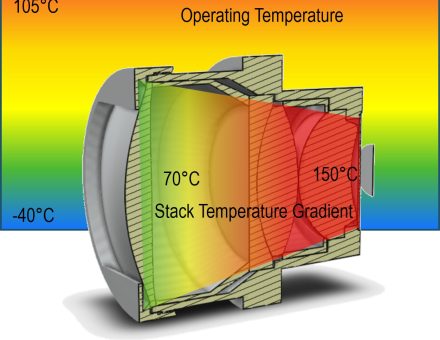
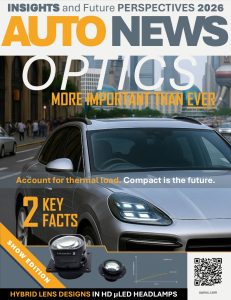
Lens hybridization — combining glass and plastic optical elements in a single assembly — is the key enabling technology for next-generation automotive µLED high-definition headlamp systems. Glass elements deliver the thermal stability and chromatic correction that LED wavelength management requires; plastic elements enable complex aspheric surfaces at production-compatible cost. Together, they achieve what neither material alone can: high-resolution pixel projection, thermal stability from -40°C to +105°C, and automotive production economics.
This paper examines the optical design principles, material selection criteria, and manufacturing considerations for hybrid lens designs in µLED HD lighting applications.
The automotive lighting industry is undergoing a technological transformation.
Traditional Matrix LED systems are giving way to microLED (µLED) projector-based headlamps capable of pixel-level control, adaptive beam shaping, and dynamic road projection. These systems are not just lighting the road — they’re becoming integral to ADAS safety features and OEM brand differentiation.
Yet, this shift introduces new challenges:
- µLED optics demand higher resolution, tighter tolerances, and compact form factors.
- The thermal loads and environmental stresses in automotive applications require systems engineered for reliability.
- To be successful, suppliers must balance performance, cost, and manufacturability — without compromising quality.
Watch the related talk from the 2025 DVN Workshop in Shanghai
What is lens hybridization, and why does it matter for automotive headlamps?
Lens hybridization, combining glass and plastic optical elements, can deliver optimized solutions for automotive µLED HD Lighting systems. Sunex’s three decades of engineering expertise, manufacturing capabilities, and proven reliability enable next-generation hybrid automotive lighting applications that balance performance, size, and cost requirements.
Why are hybrid glass-plastic lenses needed for high-definition headlamp projectors?
From Illumination to Information
In the past, headlights served a singular purpose: lighting the road. Today, they are becoming intelligent projection systems that deliver safety, comfort, and branding.
Key milestones in this evolution:
- Halogen Era → Simple reflectors with broad, uncontrolled beams.
- HID & Early LED → Increased brightness, but limited control.
- Matrix LED → Segmented control, enabling partial adaptive driving beams.
- µLED Projectors → Thousands of independently controlled pixels for high-resolution beam shaping and road-projected information.

Use Cases Driving Adoption
- Adaptive Driving Beams (ADB): Dynamic control to avoid dazzling oncoming drivers while maximizing road illumination.
- Augmented Navigation: Projecting turn-by-turn directions onto the road surface.
- Hazard Warnings: Highlighting pedestrians, cyclists, or obstacles in low visibility.
- OEM Differentiation: Unique, programmable light signatures for brand identity.
High-resolution µLED projectors don’t operate in isolation. They form part of a converging ecosystem:
- ADAS Integration: Projection-based driver alerts complement camera-based sensing.
- Sensor Fusion: Combining µLED illumination with LiDAR or radar systems.
- Software-Defined Lighting: Customizable light patterns updated over-the-air.
This evolution demands optical systems that are Reliable across multiple operating modes, Predictable under tight feedback loops with vehicle sensors, and Scalable across global vehicle platforms.
The convergence of lighting, sensing, and communication is positioning µLED-based optics as a strategic differentiator for automotive OEMs.
Whether the µLEDs experience a proliferation or just a gradual adoption will largely depend on the ability to balance performance, size, and cost. The weighting for these three factors varies from program to program, but they can never be viewed or optimized independently.
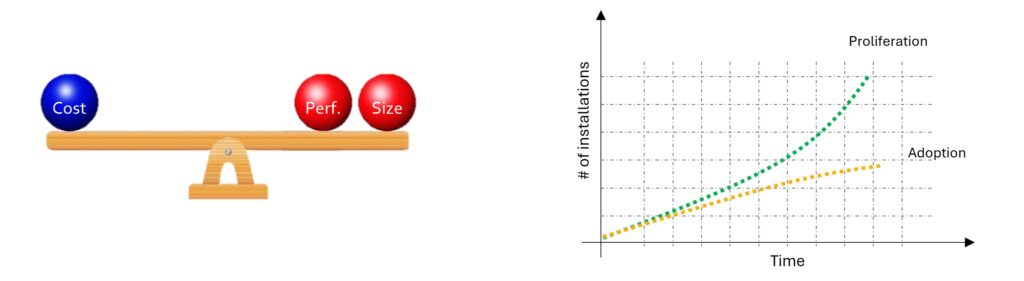
Lens hybridization (combination of glass and plastic optical elements) can bring the right balance but requires extensive design, engineering, process, and manufacturing experience to meet performance and form factor while meeting the target price without sacrificing reliability or/and increasing the supply chain risk for the customer.
Why µLEDs require more complex Optics
Transitioning from Matrix LED to µLED projectors is not just an incremental step — it’s a paradigm shift in optical engineering.
Matrix LED Optics
uLED Optics
- Optical Element count: 1-3
- Material: Glass and/or Plastics
- Shapes: Freeform, (a)spherical, complex mounting
- Assembly: click/screw into frames and carriers
- Required Z-axis alignment: ~50µm
- Optical Element count: 4-5 (typically)
- Material: Glass or Plastic
- Shapes: spherical and asphercial, simple flange
- Assembly: pre-aligned and tested in a barrel
- Required Z-axis alignment: ~5µm
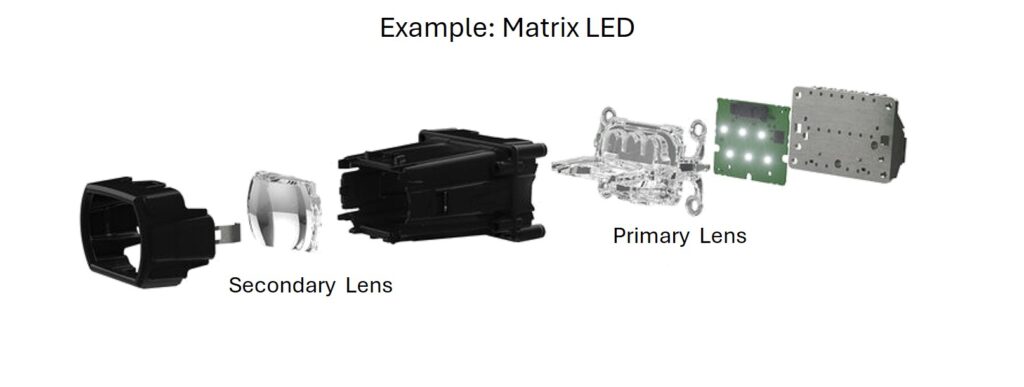
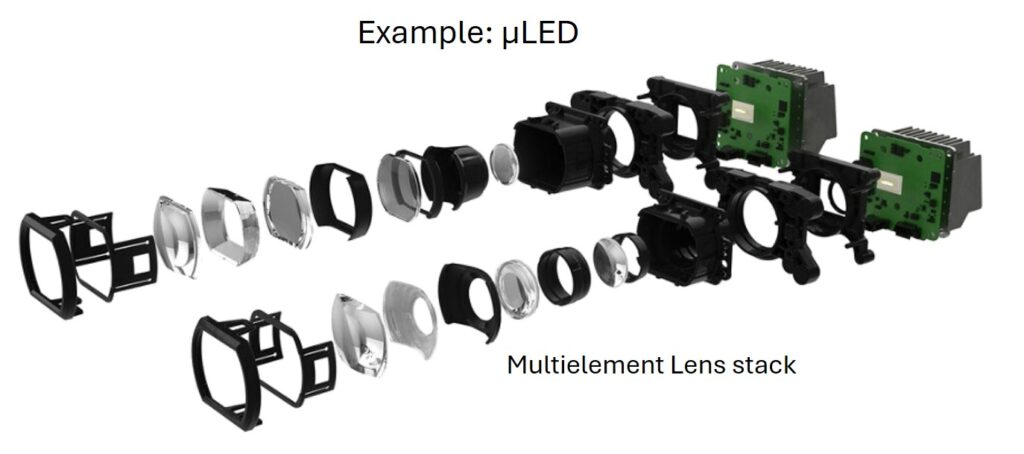
The need for a more complex optical system is based on the expectations of the OEMs that a higher pixilated source is delivering on almost imaging quality projection on one hand, and the µLED source in its fundamental concept and characteristics.
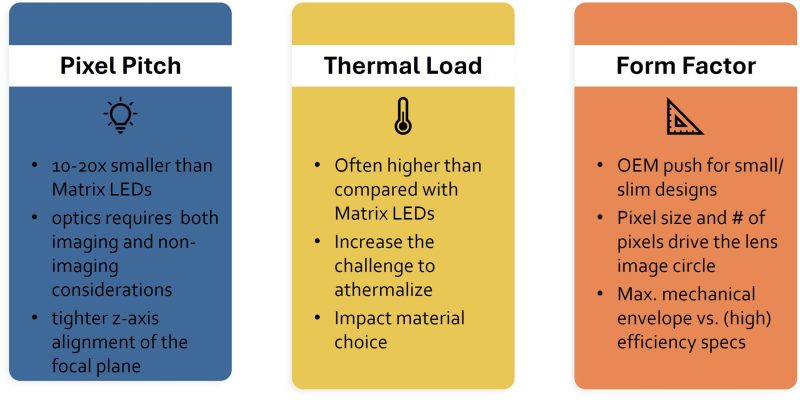
Designing and manufacturing µLED-based optical systems presents a unique set of challenges that require precision, innovation, and careful consideration at every stage. Achieving optimal performance demands tighter tolerance control across both individual components and the overall system, while the need for pixel-level accuracy pushes alignment requirements into the micron range. As element counts increase, packaging constraints become more critical, and the substantial thermal load of µLED chips necessitates advanced material selection and thermal management strategies to ensure reliability and long-term performance.
Implications for Designers & Manufacturers
- uLED-based optics require tighter tolerance control at the component and system-level.
- Pixel-level accuracy requires micron-level alignment accuracy.
- Increased element counts lead to tighter packaging constraints.
- The high thermal load of µLED chips demands innovative design and material strategies.
How does lens hybridization meet automotive qualification requirements?
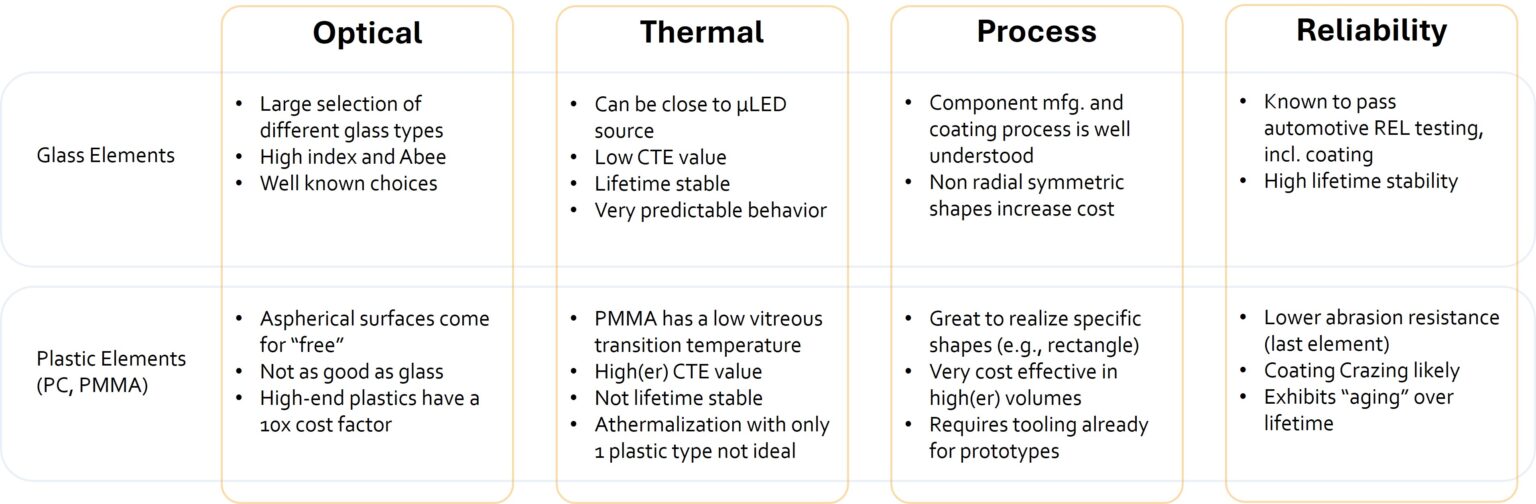
Lens hybridization leverages the complementary strengths of glass and plastic optical elements to deliver an optimal balance of performance, reliability, and manufacturability. By strategically combining materials, designers can achieve superior optical performance—minimizing chromatic aberrations, maximizing MTF, and controlling distortion—while maintaining thermal stability under aggressive automotive temperature cycles. At the same time, hybrid designs enable scalable volume manufacturing and cost-efficient production without compromising on the stringent quality standards required for automotive applications.
Lens hybridization strategically combines glass and plastic optical elements to balance:
- Optical performance (MTF, chromatic aberrations, distortion).
- Thermal stability under aggressive automotive temperature cycles.
- Volume manufacturing feasibility and cost efficiency.
What are the thermal challenges of µLED HD lighting lens design?
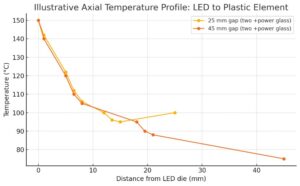
µLED sources pack extremely high luminance into tiny footprints. The result: steep internal temperature gradients across the lens stack.
Adding to that, the operating or sometimes even higher storage temperatures from Tier1 and OEM requirements, one can see how designing a fully athermalized system that has a consistent performance over a 15-year lifetime can be challenging and requires years, if not decades, of design, process, and manufacturing experience in automotive applications.

Challenges:
- Focal Point Shift of the system due to higher CTE (coefficient of linear thermal expansion) values of plastics
- Permanent Deformation Risk when certain plastic types reach their Vicat Softening Temperature (VST)
- Permanent Optical Index Change experienced by plastic materials under repeated temperature cycling
- Optical Index and Transmissivity Change due to moisture absorption of plastics
- Yellowing caused by prolonged UV exposure, impacting transmissivity and cosmetics
- Coating Crazing of AR (anti-reflective) coatings on large-format plastic elements due to expansion and contraction during thermal cycling
There are alternatives to PMMAs and PC that lessen some of the listed challenges. High-performance automotive-grade optical polymers are widely used in automotive backup, surround view, and In-Cabin camera lenses where individual optical elements are comparably small; the high cost factor of these advanced polymers is prohibiting them from wide use in HD lighting applications.
While we cannot change the laws of physics or material properties, we must acknowledge them and define design constraints accordingly without restricting the solution space in a way that would prevent us from finding a manufacturable solution. Understanding where to position different materials along the z-axis, applying best-in-class athermalization strategies, applying advanced simulations, and correlating these to real-world test data are strategies we apply at Sunex. Paramount for success is the close collaboration with the customer to design a solution that is optimized on the system level.
How does lens hybridization meet automotive qualification requirements?
Lifetime Stability Under Automotive REL Conditions
Automotive headlamps operate in harsh environments — from Arctic winters to desert summers. Reliability (REL) and Environmental test plans are designed to replicate a 15-year vehicle lifecycle. All components of an optical system undergo:
- High-Temperature endurance testing
- High-Temperature High-Humidity cycling
- Prolonged UV exposure
There are many more tests, including shock and vibration, but the ones above are typically the most challenging for a hybrid lens system. While individual test parameters and durations can change across programs, it is not uncommon for some of these tests to have monthlong durations.
Alignment & Assembly Tolerances
Unlike traditional Matrix LED systems, µLED optics require tighter tolerance control of every single optical element as well as the optomechanical components. It requires these components to be assembled, pre-aligned to each other, in a barrel. This shift in manufacturing paradigm demands tight integration between optical design, mechanical packaging, and assembly processes.
Sunex brings over 25 years of expertise in the design, development, and manufacturing of high-performance automotive optics, delivering solutions engineered for reliability in the most demanding applications. Our experience spans a wide range of automotive imaging and lighting systems, including ADAS, in-cabin monitoring, surround and rear-view cameras, and high-definition projection systems. By combining precision lens design, proprietary technologies, and rigorous manufacturing and qualification processes, Sunex ensures consistent optical performance, thermal stability, and durability. This enables automotive OEMs and Tier 1 to meet strict safety, regulatory, and performance requirements while accelerating time-to-market.
Why are hybrid glass-plastic lenses preferred for high-definition headlamp projectors?
- µLED-based projectors represent the next frontier in automotive lighting.
- Achieving pixel-level resolution requires innovative optical architectures.
- Lens hybridization offers an elegant solution to balance performance, size, and cost.
- Sunex brings decades of imaging optics experience and automotive reliability engineering to the HD Lighting market that OEMs and Tier 1 leverage to accelerate innovation and development.
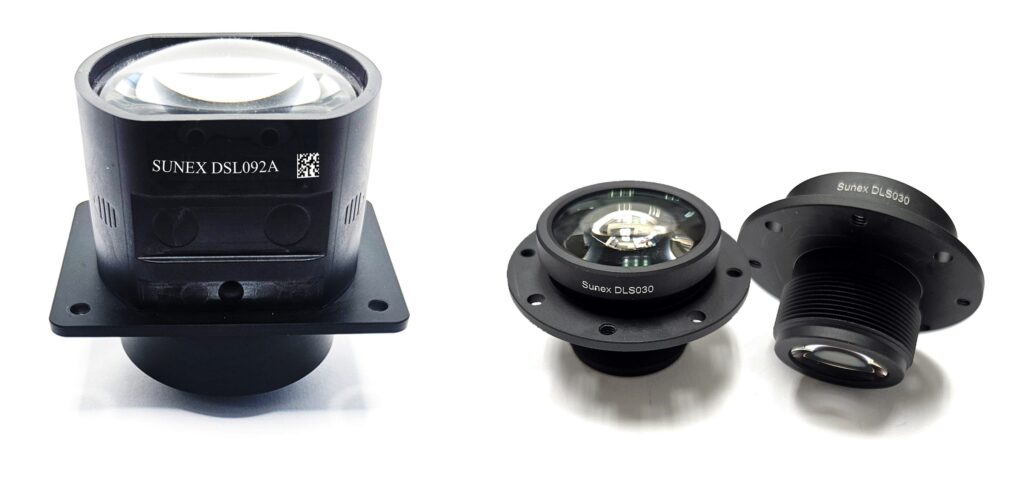
Product Examples for Hybrid and Compact Projector Lenses
Product Page: sunex.com/products/µlight/
Download PDF brochure
Hybrid and Compact Projectors