
What is the difference between resolution and contrast in imaging systems?
Designing and implementing an imaging system often begins with a fundamental question: how much detail needs to be discerned in this image? While this may seem straightforward, the answer is not always obvious. Two key metrics help guide this decision: resolution, which defines how fine of detail can be resolved, and contrast, which determines how clearly adjacent features or differences in brightness can be distinguished. A clear understanding of both parameters is essential for achieving reliable, real-world performance in applications such as automotive, medical, robotics, geospatial, and immersive imaging. At Sunex, we bring the expertise needed to engineer and optimize imaging systems to achieve the best resolution and contrast required of the application, ensuring consistent and reliable performance.
How do resolution and contrast interact in a camera lens?
In simple terms, resolution refers to the smallest detail that can be distinguished in an image. Several factors influence system resolution, including the lens design, sensor pixel size, optical aberrations, and overall system geometry. A higher-resolution lens-imager combination enables finer features to be captured, such as sharp object edges, subtle textures in terrain mapping, or small defects in inspection and medical imaging.
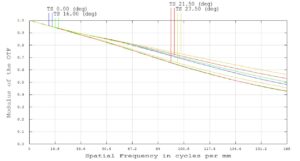
Resolution can be measured using spatial frequency, which represents how frequently image features repeat over a given distance. Typically, this is shown in a collection of black and white lines and is measured in “line pairs per millimeter”. Higher spatial frequency corresponds to finer details and requires a higher resolution to capture them accurately. Understanding spatial frequency is important because it provides the basis for comprehending a system’s Modulation Transfer Function (MTF), which describes a system’s ability to reproduce contrast at different spatial frequencies. In other words, spatial frequency tells you the level of detail you are trying to resolve and MTF tells you how well your system can reproduce them. One way to visualize the relationship between spatial frequency and MTF is with our MTF Impact Simulator, which shows how varying the MTF value affects image quality across different spatial frequencies.

How do I specify resolution and contrast requirements for a machine vision lens?
- Make sure your sensor’s pixel size matches the lens resolution capability (no sense in pairing a 12 MP sensor with a lens that can only resolve ~2 MP worth of detail).
- Consider the effective focal length (EFL) and field of view (FOV): for a given imager, a longer focal length (narrower FOV) often yields higher detail.
- Optical aberrations (e.g., astigmatism, spherical, coma) degrade resolution: good lens design matters.
What is Contrast?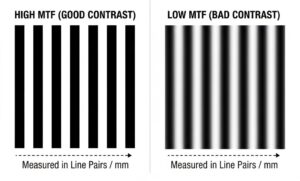
Contrast refers to the difference in brightness (or signal) between adjacent features in your image. Practically speaking, it describes how well a dark object stands out from a light background, or how clearly two adjacent features can be distinguished when their brightness levels are similar. If we think back to spatial frequency and line pairs, contrast would be the amount of difference in brightness between the black and white lines. This can best be seen using our MTF Impact Simulator: at a lower MTF value, the lines begin to blur together since the contrast is reduced. Even if the resolution is high, if the contrast is low, then the fine features could get lost in fog, scattering, glare, or lens flare. This is why contrast is just as critical as resolution. Without sufficient contrast, the details a system is theoretically capable of resolving may not appear in the final image.
Key points to consider:
- Relative illumination: At wide FOVs, edge illumination often falls off, reducing brightness and contrast towards the edge of the image.
- Scattering, ghosting and flare: These effects degrade the contrast and can be a result of lens coatings, internal baffling, and/or the lens element design.
- High dynamic range (HDR) environments (e.g., sports arena lighting, drone aerial with shadow & sun): Ensuring sufficient contrast may require optical and/or electronic compensation (e.g., HDR lens/sensor, variable aperture).
Resolution × Contrast
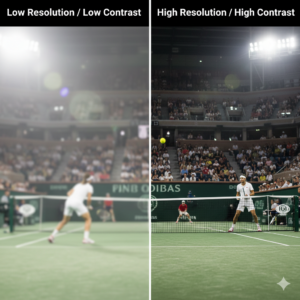
Resolution and contrast go hand in hand. High resolution by itself is not enough, if contrast is too low, the system may have plenty of pixels, but the fine details won’t appear clearly since the brightness differences that define them would be too small. Conversely, high contrast with low resolution might show strong overall shapes or silhouettes, but the system won’t be able to resolve the fine features and textures that make up the image. Both metrics must work together for an imaging system to deliver meaningful detail.
Key points to consider:
- Sensor and lens match: A lens can only resolve high spatial frequencies (details) if it maintains its contrast at those frequencies. Optical metrics, like MTF, describe how contrast falls off at increasing spatial frequencies, helping quantify how well a lens and sensor work together.
- Field of view and working distance: For example, in drone inspection over a terrain, a single wide FOV might cover the entire area of interest, but it would reduce effective resolution per meter. Additionally, wider FOVs are more susceptible to edge contrast fall off.
- Environmental factors: Haze, motion blur, or low-light environments (common in immersive imaging settings) reduce contrast and therefore limit the usable resolution.
How does Sunex help you optimize an imaging system?
- At Sunex, we leverage over 25 years of optical design experience and a portfolio of 300+ off-the-shelf lenses to match the right lens to your sensor and application, achieving the optimal resolution and contrast. sunex.com+1
- Through the Optics Wizards at optics-online.com, you can simulate resolution and contrast tradeoffs online before committing to hardware. Allowing faster evaluation and design confidence earlier on. Sunex Optics-online.com
- Whether you’re developing systems for sports/immersive imaging, geospatial mapping, drones, robotics, or medical devices, our team of optical and application engineers can help you select the right combination of lens, sensor, and system geometry to achieve your target resolution (e.g., line pairs per mm, pixels per foot) and contrast (e.g., minimum detectable contrast in your scene).
Conclusion
In a world where imaging demands continue to rise, the ability to resolve fine detail with clear contrast is what separates “good enough” from “mission-ready”. At Sunex, we partner with you from the start, leveraging our design expertise, simulation tools, and extensive lens portfolio to ensure resolution and contrast aren’t just afterthoughts, but built-in strengths.
Let’s start a conversation about your next system: whether it’s a drone-based geospatial survey, an immersive 360° VR capture rig, or a high-precision medical imaging lens, we can help optimize for resolution and contrast, so your imaging system delivers real-world value.
The Sunex U.S. Team